Atmospheric vs Blown Forge Burner
Quick answer
Atmospheric burners pull their own combustion air through a venturi, so they run anywhere with no power - the simple, cheap choice most beginners should start with. Blown and ribbon burners use a fan to force air, giving more even, controllable heat that shines in big chambers and serious forge welding, but they need electricity and cost more. Match the burner to your chamber size and power access.
The core difference: how each burner gets its air
Every propane forge burner has to mix fuel with the right amount of air. The two families differ only in how they pull that off.
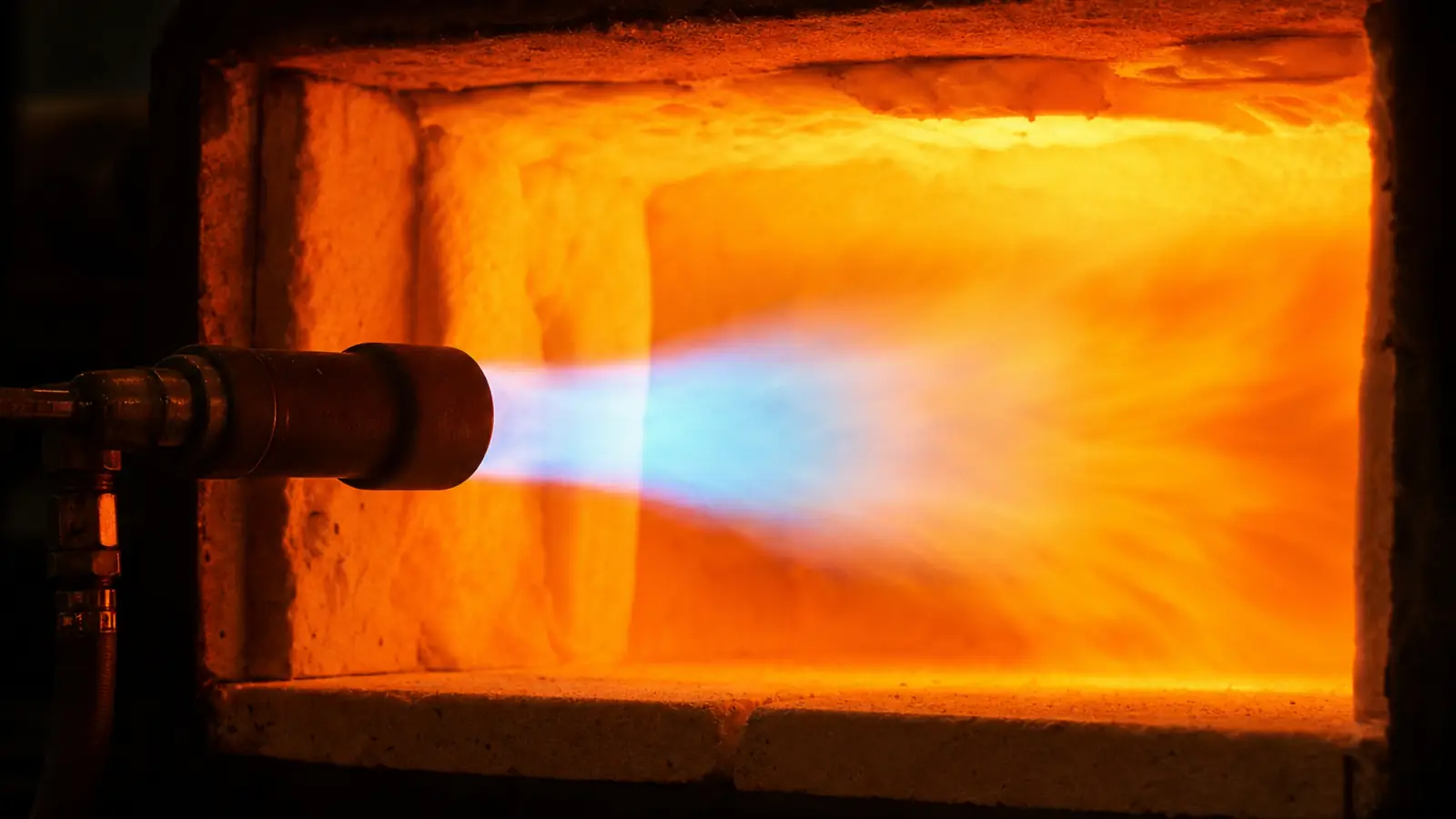
An atmospheric burner (also called naturally-aspirated or venturi) shoots propane through a small brass orifice into an open tube. That fast gas jet drags room air in behind it - the venturi effect - with no fan and no moving parts. You control the flame with just two things: gas pressure at the regulator and an air choke sleeve near the intake. This is the classic 3/4-inch or 1-inch "Frosty T" or Reil-style burner most beginners meet first.
A blown burner (forced-air) uses a small blower or fan to push a measured stream of air into a mixing pipe, where propane is injected. Because you set the air with the fan and the gas with the regulator, you can dial in the flame precisely - but you now need electricity.
A ribbon burner is usually a blown burner with a twist: instead of one flame port, the gas-air mix feeds a refractory block drilled with many small holes. The result is a soft, wide curtain of dozens of little flames that heats a chamber very evenly.
| Feature | Atmospheric | Blown | Ribbon |
|---|---|---|---|
| Air supply | Venturi (self) | Fan/blower | Fan/blower |
| Needs power | No | Yes | Yes |
| Heat evenness | Good | Very good | Excellent |
| Forge welding | OK, tune it | Yes | Yes, best |
| Noise | Loud jet roar | Blower hum | Soft, quiet |
| Up-front cost | Low | Medium | Medium-high |
| Best for | Beginners, portable | Big chambers | Even heat |
Heat control, evenness, and forge welding
For everyday forging - drawing out tapers, bending, punching, making hooks and tongs - an atmospheric burner is plenty. A well-tuned 3/4-inch burner (~90,000 BTU/hr) brings a small chamber up to a bright orange working heat in minutes. The catch is that a single venturi flame heats hardest right in front of the port, so long or wide chambers can show a hot spot. You manage that by sizing the burner to the chamber and rotating your stock.
Blown and especially ribbon burners win on evenness and precise control. Because you set air and gas independently, you can hold a soft, stable heat and push more total BTU without the flame blowing itself out. That even soak is why ribbon burners are the favorite for serious forge welding and pattern-welded (damascus) work - you want the whole billet at welding heat at once, not just the face nearest one flame. A blown setup also reaches welding temperature more reliably in a larger or poorly insulated chamber.
Either type can forge-weld if it is tuned to a neutral-to-slightly-reducing flame and the forge is well lined. Insulation matters as much as the burner here - a tight kaowool-and-firebrick chamber holds heat so the burner does not have to fight losses.
Burner and regulator to start with
Most beginners get the best value from a quality atmospheric burner plus an adjustable 0-30 PSI regulator, which gives you the pressure range to tune the flame. If you later move to a blown build, the same regulator and propane plumbing carry over. Compare complete options on our best propane forge burner roundup.
3/4 in naturally-aspirated forge burner
3/4 in
- BTU/hr
- 90,000
- Burners
- 1
- Regulator
- 0-30 PSI
Heats roughly 300-350 cu in of chamber. The default single-burner size for a first forge. Needs a 0-20 or 0-30 PSI regulator.
1 in high-output forge burner
1 in
- BTU/hr
- 150,000
- Burners
- 1
- Regulator
- 0-30 PSI
Feeds a larger chamber (up to ~700 cu in) or reaches welding heat. Hungrier - pair with a 30/40 lb tank to avoid freeze-up.
Blown (ribbon) forge burner
forced-air
- BTU/hr
- 120,000
- Burners
- 1
- Regulator
- 0-30 PSI
A fan feeds air for even, controllable heat and easy welding, but needs power and more setup than a naturally-aspirated burner.
Adjustable propane regulator 0-30 PSI
POL/QCC-1 fitting
- Regulator
- 0-30 PSI
0-30 PSI range reaches forge-welding pressure. Confirm the tank fitting (QCC-1) matches your tank.
Adjustable propane regulator 0-20 PSI
POL/QCC-1 fitting
- Regulator
- 0-20 PSI
Fine for general forging heat. If you plan to forge-weld, choose the 0-30 PSI version instead.
Noise, power, cost, and building your own
Noise surprises a lot of first-timers. Atmospheric burners are loud - that fast venturi jet makes a real roar you feel across a two-car garage. Blown burners trade the jet roar for blower hum, and ribbon burners run the quietest of all thanks to their soft, spread-out flame. If you forge in a residential neighborhood or share a shop wall, that difference is worth weighing.
Power is the other deciding factor. An atmospheric burner runs on a propane tank alone, so it works on a driveway, at a demo, or anywhere off-grid. A blown or ribbon burner needs a wall outlet or battery pack for the fan - lose power and the flame is gone. If you want a truly portable rig, atmospheric is the honest answer.
On cost, an atmospheric burner is the cheapest way into forging. Blown adds the price of a blower and often a ball valve or gate to trim air; ribbon adds a cast refractory block on top of that. All three are DIY-friendly - the atmospheric burner is the classic weekend build, while ribbon burners reward patience with the pour. If you are assembling a forge from scratch, our propane forge build guide walks the whole process, and the burner tuning guide covers dialing in either type.
Which should a beginner buy?
Start atmospheric. It is simpler, cheaper, needs no power, and will forge every beginner project you can name for years. There is less to go wrong and less to learn before your first heat.
Step up to blown or ribbon when you have a specific reason: a large chamber a single venturi flame struggles to fill, a plan to do steady forge welding or damascus, or a shop where the roar of an atmospheric burner is a problem. Those are real upgrades, not vanity ones - but they solve problems you may not have yet.
Whatever you choose, size the burner to your chamber before you buy. As a rough guide, a 3/4-inch burner (~90,000 BTU/hr) suits roughly 350 cubic inches of interior volume and a 1-inch burner (~150,000 BTU/hr) about 700 cubic inches. Run your own numbers below.
Frequently asked questions
Is an atmospheric or blown burner better for a beginner?
For most beginners, atmospheric. It costs less, has no moving parts, needs no electricity, and forges every starter project well. A blown or ribbon burner earns its place later if you take on serious forge welding, run a large chamber, or need a quieter flame. Start simple, learn to tune it, and upgrade only when you hit a specific limit.
Do I really need a fan for a blown forge burner?
Yes. A blown burner defines its air supply with a small blower or fan, so it will not run without one - and without power the flame goes out. That is the trade for the precise, even heat blown and ribbon burners give. If you want a burner that works off-grid on a propane tank alone, choose an atmospheric (venturi) design instead.
Can an atmospheric burner forge weld?
Yes, with a well-tuned neutral-to-slightly-reducing flame, an adjustable regulator, and a tight, well-insulated chamber. Many smiths forge weld with atmospheric burners every day. The catch is evenness: a single venturi flame heats hardest near its port, so large billets can heat unevenly. For steady welding and pattern-welded steel, a blown or ribbon burner soaks the whole piece more consistently.
What is a ribbon burner and is it worth it?
A ribbon burner is usually a blown burner that feeds a cast refractory block drilled with many small ports, producing a soft curtain of dozens of tiny flames. It heats a chamber very evenly and runs quietly, which makes it a favorite for forge welding and damascus. It is worth it once even heat or noise is a real problem - not as a first burner.
Are atmospheric burners loud?
Yes, noticeably. The high-speed propane jet that pulls in combustion air makes a loud roar you hear across a garage. Blown burners swap that for blower hum, and ribbon burners are the quietest of the three because their spread-out flame burns softly. If you forge in a residential area or a shared shop, noise is a fair reason to lean toward a ribbon burner.
How many BTU does my burner need?
Size it to your chamber's interior volume. As a rough rule, a 3/4-inch burner around 90,000 BTU/hr heats about 350 cubic inches, and a 1-inch burner around 150,000 BTU/hr heats about 700 cubic inches. Under-size and you never reach welding heat; over-size and you waste propane and overheat the shell. Use the forge burner BTU calculator to match burner output to your build.
Last verified 2026-06. Specs, sizes and market prices change - confirm details on the retailer page before buying.