Harbor Freight Propane Forge Review
Quick answer
The Harbor Freight-style single-burner propane forge is a cheap way to start hitting hot steel, but it ships with a low-range regulator and thin lining that most owners outgrow quickly. Treat it as a bare chassis: budget a 0-30 PSI regulator for welding heat, plan on adding ceramic blanket and rigidizer, and read the listing closely because budget-brand specs and quality control vary batch to batch.
What a hardware-store forge actually is
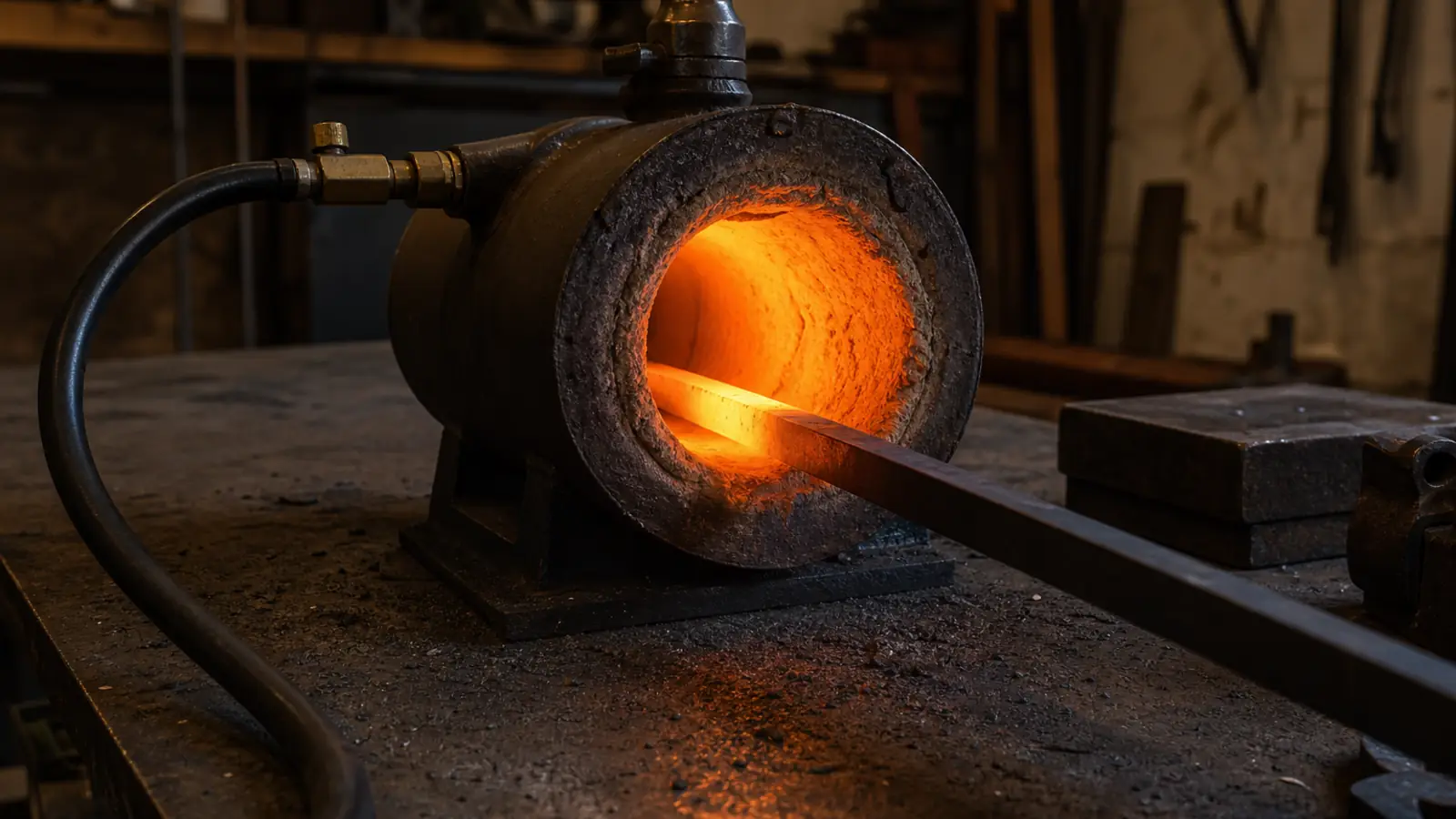
Harbor Freight and similar big-box retailers periodically stock a Chicago Electric-branded single-burner propane forge, and near-identical units show up under a rotating cast of import brand names. Mechanically they are all the same recipe: one atmospheric (naturally aspirated) burner, a welded steel shell, a ceramic-fiber or castable lining, and a small low-range regulator. When one is actually in stock, it gets a beginner heating steel to a working orange faster and cheaper than most scratch builds.
The honest framing is that you are buying a chassis, not a finished tool. The forge body and burner are usually serviceable out of the box. The two parts most owners end up replacing are the regulator and, eventually, the lining. If you walk in expecting those upgrades, the value math works out well. If you expect clean forge-welding heat on day one, you will be frustrated. For the wider field of options, our best propane forge for beginners roundup puts these budget units in context.
| Spec | Typical figure | What it means for you |
|---|---|---|
| Burners | 1 atmospheric | One hot zone; fine for knives and small stock |
| Advertised BTU | ~90,000-120,000 | A marketing figure; real heat depends on tuning |
| Regulator | 0-10 PSI (low range) | Caps top-end heat; the first upgrade for most |
| Chamber volume | ~200-350 cu in | Fits small work; short for long or bulky bar |
| Lining | Thin ceramic blanket | Functional, but wants rigidizer and more depth |
| Price | Budget entry tier | Confirm current price; do not trust old numbers |
Read the BTU number with skepticism
The big BTU figure on the box is a headline, not a promise. Advertised output assumes ideal pressure, a clean orifice, and a perfectly tuned burner - conditions a $150 forge rarely meets straight from the carton. What you actually get depends on how well the atmospheric burner is set up and how tight the chamber seals.
Before you assume a unit is underpowered, learn to tune it. A slightly rich or lean flame, a burner that sits too deep or too shallow, and an oversized door opening all rob heat. Our guide to tuning a propane forge burner walks through the adjustments, and the forge burner BTU calculator helps you sanity-check whether a single burner even matches your chamber size before you blame the hardware.
If you want the budget-forge experience without the headaches, the smarter play is often a purpose-built single-burner forge paired with a proper 0-30 PSI regulator from the start. That combination gets you the same easy entry point but with the top-end pressure this class of forge needs to reach welding heat.
Compact single-burner propane forge
14 x 8 x 8 in shell
- BTU/hr
- 90,000
- Burners
- 1
- Chamber (in)
- 9 x 4.5 x 3
- Weight
- 22 lb
- Regulator
- 0-20 PSI
- Firebrick
- Included
Good first forge for knives and small stock. Confirm the interior length fits your longest workpiece before buying.
Long single-burner knife forge
18 x 8 x 8 in shell
- BTU/hr
- 100,000
- Burners
- 1
- Chamber (in)
- 12 x 4.5 x 3
- Weight
- 27 lb
- Regulator
- 0-30 PSI
- Firebrick
- Included
Longer chamber suits blade work. Ships with a 0-30 PSI regulator on most listings - verify the range.
Economy single-burner forge
12 x 7 x 7 in shell
- BTU/hr
- 80,000
- Burners
- 1
- Chamber (in)
- 8 x 4 x 3
- Weight
- 18 lb
- Regulator
- 0-20 PSI
- Firebrick
- Included
Lowest-cost entry option. Interior is short - fine for hooks and small knives, tight for anything long.
Single-burner farrier-style forge (open ends)
15 x 8 x 8 in shell
- BTU/hr
- 95,000
- Burners
- 1
- Chamber (in)
- 10 x 5 x 3
- Weight
- 24 lb
- Regulator
- 0-20 PSI
- Firebrick
- Included
Open front and back let you pass long bar through. Open ends waste some heat - plan for a firebrick baffle.
Single-burner forge with front door
16 x 9 x 9 in shell
- BTU/hr
- 110,000
- Burners
- 1
- Chamber (in)
- 9 x 5 x 3.5
- Weight
- 26 lb
- Regulator
- 0-30 PSI
- Firebrick
- Included
Front door helps hold welding heat. Confirm whether a 0-30 PSI regulator is included for forge-welding pressure.
Adjustable propane regulator 0-30 PSI
POL/QCC-1 fitting
- Regulator
- 0-30 PSI
0-30 PSI range reaches forge-welding pressure. Confirm the tank fitting (QCC-1) matches your tank.
Adjustable propane regulator 0-20 PSI
POL/QCC-1 fitting
- Regulator
- 0-20 PSI
Fine for general forging heat. If you plan to forge-weld, choose the 0-30 PSI version instead.
The regulator is the first real upgrade
The single biggest limitation on most budget forges is the included regulator. Many ship with a fixed or low-range unit topping out around 5-10 PSI. That is enough to reach a forging orange for shaping mild steel, but it often falls short of the sustained yellow-white heat that forge welding demands.
Swapping to an adjustable 0-30 PSI regulator is the cheap fix that unlocks the forge's real ceiling. It lets you dial pressure up for welding heat and back down to save fuel on light work. If you are unsure which fitting and hose you need, the propane forge regulator guide covers POL versus ACME connections, hose ratings, and why you never run an unregulated cylinder into a burner. Budget the regulator into the purchase, not as an afterthought - it is the difference between a toy and a working tool.
What to verify before you buy
Budget brands live and die on quality control, and QC on import forges is genuinely variable. Two units off the same shelf can differ in weld quality, lining thickness, and burner alignment. Before you commit, check:
- The current regulator range. If it is a low-pressure or fixed unit, plan the 0-30 PSI swap immediately.
- Chamber dimensions. Measure against the longest stock you plan to heat; short chambers force you to work in the flame at the door.
- Lining condition and depth. Thin, un-rigidized ceramic blanket wears fast; budget for rigidizer and possibly a firebrick floor. Our forge insulation guide explains how to shore it up.
- Return and warranty terms. With variable QC, an easy return window is worth real money.
- Fittings and hose rating. Confirm the hose is rated for propane and the connections match your tank.
A note on the lining: many owners report the factory blanket packs down or crumbles within a season of regular use. That is normal for the price point, not a defect - it just means insulation is a consumable you will refresh.
How it compares to the VEVOR approach
The Harbor Freight-style unit and the VEVOR forges occupy the same budget shelf, and the buying logic is nearly identical: cheap chassis, expect to upgrade the regulator and lining. The main practical differences tend to be availability and configuration - VEVOR sells online in more sizes and burner counts, while the Chicago Electric unit is a single-burner design you find in-store when it is stocked.
We apply the same spec-sheet, no-hands-on framing in our VEVOR propane forge review, so read both if you are cross-shopping. If you think you may want a longer heat or a bigger chamber down the line, the single vs double burner comparison is worth a look before you settle on any single-burner budget model.
Frequently asked questions
Is the Harbor Freight propane forge good for beginners?
It can be a reasonable entry point if you accept upgrades. For shaping mild steel and learning hammer control, the single burner does the job. The catch is the low-range regulator and thin lining, which most owners replace. If you budget a 0-30 PSI regulator and some rigidizer up front, it is a cheap way to start. If you expect welding heat and a durable lining out of the box, you will be disappointed.
Can the Chicago Electric forge reach forge-welding temperature?
Often not with the stock regulator. Forge welding needs a sustained yellow-white heat, roughly 2200-2400F, and the included low-pressure regulator usually caps out too soon. Swapping to an adjustable 0-30 PSI regulator lets you push pressure high enough. You will also want a tighter chamber and rigidized lining to hold that heat, so treat welding capability as an upgrade goal rather than a factory feature.
Why does everyone say to upgrade the regulator?
Because the included regulator is usually the main heat bottleneck. Many budget forges ship with a fixed or low-range unit around 5-10 PSI, which is fine for a forging orange but short of welding heat. An adjustable 0-30 PSI regulator raises the ceiling and lets you throttle down to save fuel. It is an inexpensive part that changes the forge from a limited toy into a genuinely useful tool.
How long does the lining last?
Expect the factory ceramic blanket to pack down or degrade within a season of regular use - that is normal at this price, not a defect. Applying rigidizer to the blanket and adding a firebrick floor extends its life and improves efficiency. Plan to refresh insulation periodically the same way you would replace any consumable, and check the lining condition before each firing session.
Harbor Freight forge or VEVOR - which is better for a beginner?
They are close cousins with the same budget trade-offs, so the decision usually comes down to availability, size, and price on the day you buy. VEVOR offers more online configurations and burner counts; the Chicago Electric unit is a single-burner you grab in-store when stocked. Both need the regulator and lining upgrades. Read both reviews and compare current chamber size, regulator range, and return terms before deciding.
Last verified 2026-06. Specs, sizes and market prices change - confirm details on the retailer page before buying.