Propane Forge Regulator: Choosing and Building Your Gas Train
Quick answer
For a propane forge you want an adjustable high-pressure regulator, not the fixed low-pressure kind sold with grills. A 0-20 PSI regulator handles general forging; step up to 0-30 PSI if you plan to forge weld. Pair it with an LP-rated hose, the correct tank fitting (POL or QCC-1), and ideally a pressure gauge for repeatable, dial-in settings.
Why a forge needs an adjustable high-pressure regulator
The single most common beginner mistake is trying to run a forge on the regulator that came with a gas grill. Those fixed low-pressure regulators deliver roughly 0.5 PSI (about 11 inches of water column) and cannot push enough gas to bring steel to a working orange or yellow heat. A forge burner is hungry: a typical 3/4 in naturally-aspirated burner wants somewhere in the 5-15 PSI range under load.
What you actually need is an adjustable high-pressure regulator. It lets you dial gas pressure up or down with a knob so you can control forge temperature, save fuel at idle, and reach welding heat when you want it. Two ranges cover almost every beginner: 0-20 PSI for general forging and 0-30 PSI if you also plan to forge weld. If you are still choosing the burner itself, start with our best propane forge burner picks, then match the regulator to it here.
| Regulator | PSI range | Best for | Verdict |
|---|---|---|---|
| BBQ / appliance | ~0.5 PSI fixed | Grills, fire pits | Too weak - skip |
| Adjustable HP | 0-20 PSI | General forging | Fine for most beginners |
| Adjustable HP | 0-30 PSI | Forge welding heat | Best all-around pick |
| High-output HP | 0-60 PSI | Large / multi-burner | Overkill for one burner |
Estimate cost per hour at your pressure
Regulator and gas-train parts to look at
You can buy the pieces separately or as a matched hose-and-regulator kit. For a first build, a complete kit removes the guesswork of matching threads and fittings. Look for an adjustable high-pressure unit in the 0-20 or 0-30 PSI range, an LP-rated hose, and a burner sized to your forge chamber.
Adjustable propane regulator 0-30 PSI
POL/QCC-1 fitting
- Regulator
- 0-30 PSI
0-30 PSI range reaches forge-welding pressure. Confirm the tank fitting (QCC-1) matches your tank.
Adjustable propane regulator 0-20 PSI
POL/QCC-1 fitting
- Regulator
- 0-20 PSI
Fine for general forging heat. If you plan to forge-weld, choose the 0-30 PSI version instead.
Propane hose and 0-30 PSI regulator kit
10 ft hose
- Regulator
- 0-30 PSI
Complete gas train for most forges. Leak-test every joint with soapy water before first light.
Propane regulator, hose and gauge kit
8 ft hose
- Regulator
- 0-30 PSI
Includes a pressure gauge so you can set PSI repeatably. Verify the hose is rated for LP gas, not air.
3/4 in naturally-aspirated forge burner
3/4 in
- BTU/hr
- 90,000
- Burners
- 1
- Regulator
- 0-30 PSI
Heats roughly 300-350 cu in of chamber. The default single-burner size for a first forge. Needs a 0-20 or 0-30 PSI regulator.
1 in high-output forge burner
1 in
- BTU/hr
- 150,000
- Burners
- 1
- Regulator
- 0-30 PSI
Feeds a larger chamber (up to ~700 cu in) or reaches welding heat. Hungrier - pair with a 30/40 lb tank to avoid freeze-up.
Blown (ribbon) forge burner
forced-air
- BTU/hr
- 120,000
- Burners
- 1
- Regulator
- 0-30 PSI
A fan feeds air for even, controllable heat and easy welding, but needs power and more setup than a naturally-aspirated burner.
The full gas train: tank to burner
A forge gas train is short and simple: tank -> regulator -> hose -> burner. Each junction has to be correct and leak-free.
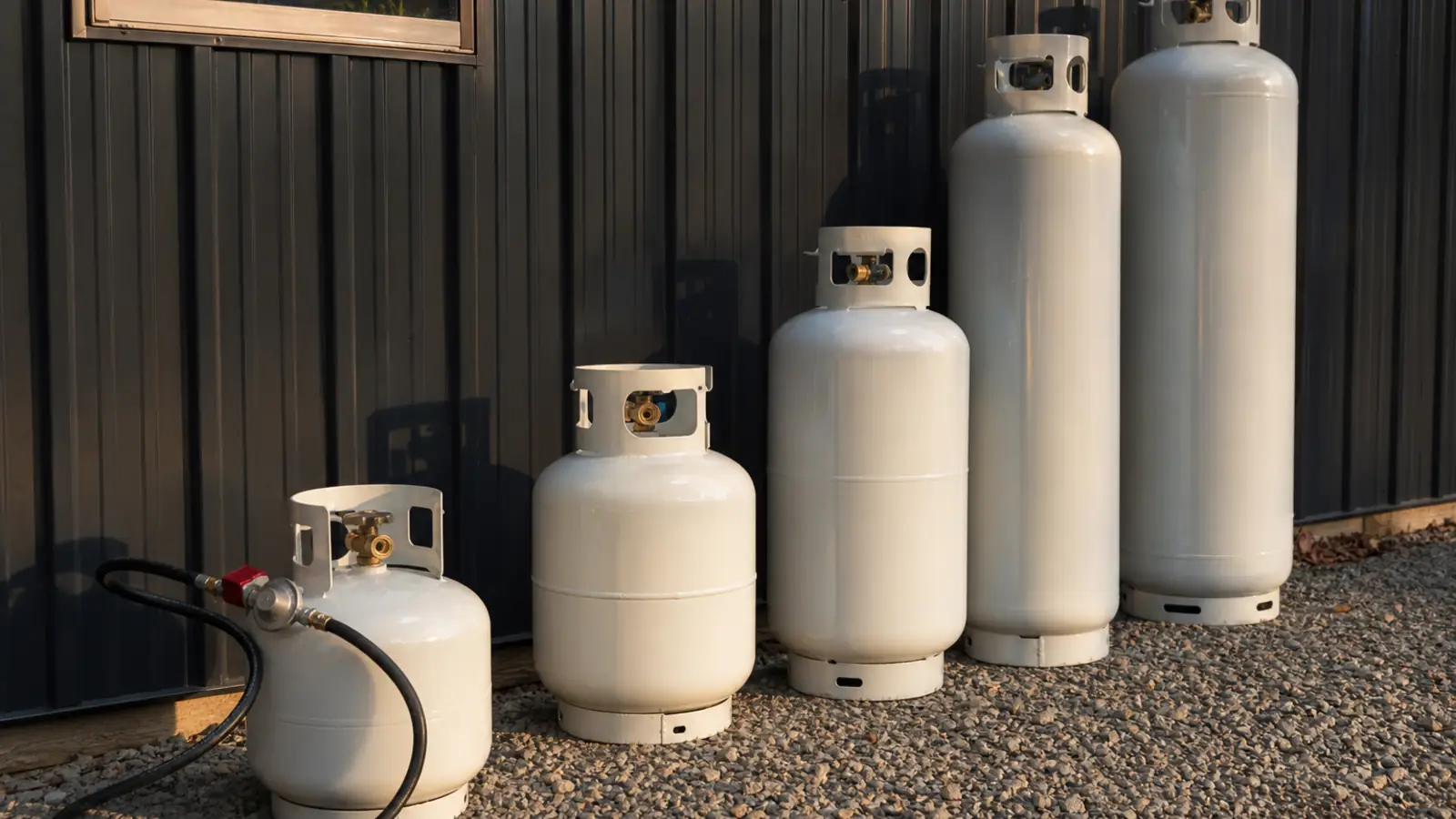
- Tank connection. Modern 20-40 lb US propane cylinders use a QCC-1 / Type 1 valve outlet (the big external hand-tightened plastic nut, no wrench needed). Older tanks and many refillable forge tanks use POL, a left-hand internal thread that tightens counter-clockwise. Match your regulator's inlet to your tank valve, or use an approved adapter. If you are still picking a bottle, see propane tank sizes for forges.
- Regulator. The adjustable high-pressure body with your control knob. An inline 0-30 PSI gauge is optional but genuinely useful: it turns "about a quarter turn" into a number you can write down and repeat.
- Hose. Use a thermoplastic LP-rated hose stamped for propane service. Do not substitute a pneumatic air hose or a clear vinyl line; those are not rated for LP gas and can fail.
- Burner. The mixer and flare that actually fire the forge. Size gas pressure to the burner and chamber. Our how to build a propane forge guide walks through assembling the whole thing.
0-20 vs 0-30 PSI: how much do you need?
For general forging - drawing out, tapering, bending, punching, making hooks and simple tools - a 0-20 PSI regulator is plenty. Most single-burner beginner forges settle in around 5-12 PSI at a bright forging heat, so a 0-20 unit gives you comfortable headroom.
Step up to 0-30 PSI if forge welding is on your radar. Welding wants a hotter, near-yellow "sweating" heat and roughly 25% more gas than plain forging, so the extra top-end range matters. It is the safer default pick because it costs little more and does everything a 0-20 does. If welding is the goal, pair the regulator with the technique in forge welding for beginners and flux.
Unsure how much burner and pressure your chamber calls for? Run your interior volume through the forge burner BTU calculator - one 3/4 in burner (~90k BTU/hr) heats roughly 350 cubic inches, a 1 in burner about twice that.
Common mistakes to avoid
- Using a BBQ regulator. Fixed low-pressure units simply cannot reach forging heat. If your forge tops out at a dull red glow, this is usually why.
- The wrong hose. Air hose and vinyl tubing are not LP-rated. Buy a hose stamped for propane, or a matched hose-and-regulator kit so the fittings already agree.
- Mismatched fittings. Forcing a QCC-1 regulator onto a POL tank (or vice versa) leads to cross-threading and leaks. Confirm POL vs QCC-1 before you buy.
- Over-pressuring a small tank. A 20 lb bottle can only vaporize so fast - around 80k BTU/hr at 60F, and roughly half that near freezing. Cranking a small tank to feed a big burner draws it down, frosts the cylinder, and the pressure sags. The fix is a bigger tank or a two-tank manifold, not more knob; details in propane tank sizes for forges.
- No gauge, no notes. Without a gauge you are guessing every session. A cheap inline gauge lets you log the pressure that gave a clean weld or a perfect bending heat.
For how the regulator fits into the rest of a first setup, see blacksmith shop setup and our propane forge for beginners picks.
Frequently asked questions
Can I use a grill regulator on a propane forge?
No. Gas grill regulators are fixed low-pressure, around 0.5 PSI (11 inches water column), and cannot supply enough propane to reach forging heat. A forge needs an adjustable high-pressure regulator, typically dialed to roughly 5-15 PSI under load. Buy a 0-20 or 0-30 PSI adjustable unit instead.
Do I need a 0-30 PSI regulator or is 0-20 enough?
For general forging - drawing out, bending, simple tools - a 0-20 PSI regulator is plenty; most single-burner forges run around 5-12 PSI. Choose 0-30 PSI if you plan to forge weld, since welding needs a hotter yellow heat and about 25% more gas. A 0-30 unit does everything a 0-20 does, so it is the safer default.
What is the difference between POL and QCC-1 fittings?
They are two propane tank connections. QCC-1 (also called Type 1) is the modern outlet on 20-40 lb US cylinders - a large external plastic nut you hand-tighten, no wrench. POL is an older internal left-hand thread that tightens counter-clockwise, common on refillable forge tanks. Match your regulator's inlet to your tank valve, or use an approved adapter.
What hose should I use for a propane forge?
Use a thermoplastic hose specifically rated and stamped for LP (propane) service. Never substitute a pneumatic air hose or clear vinyl tubing - they are not rated for propane and can fail or leak. Many builders buy a matched hose-and-regulator kit so the end fittings already match the regulator and burner.
Do I need a pressure gauge on my forge regulator?
It is optional but genuinely worth it. A gauge turns vague knob positions into numbers you can record and repeat, so once you find the pressure that gives a clean forge weld or an ideal bending heat, you can return to it exactly. Many adjustable regulators come with a 0-30 PSI gauge, or you can add an inline one.
Why does my forge lose heat and the tank get cold?
That frost and pressure sag mean you are drawing gas faster than the cylinder can vaporize. A 20 lb tank makes about 80k BTU/hr at 60F and roughly half that near freezing. Opening the regulator wider will not fix it - move to a larger 30-40 lb tank or manifold two tanks together to increase vaporization capacity.
Last verified 2026-06. Specs, sizes and market prices change - confirm details on the retailer page before buying.