Propane Forge vs Coal Forge: Which Should a Beginner Buy?
Quick answer
For most beginners, a propane forge is the better first forge. It lights in seconds, holds a steady heat you can walk away from, runs clean, and moves easily - ideal for knives and small work. A coal or coke forge hits higher localized heat and swallows any size stock, but it is smoky, needs fuel sourcing, and takes real fire-management skill.
The short answer for beginners
If you are buying your first forge and you mostly want to make knives, hooks, bottle openers, and small tools, buy a propane gas forge. A gas forge is the least fussy way to reach forging heat: open the valve, light the burner, and within a few minutes you are working steel at a temperature you can hold steady all afternoon. There is no fire to build, no ash to rake, and almost no smoke.
A coal or coke forge is not a beginner mistake - plenty of smiths swear by it - but it asks more of you on day one. You have to build and tend a fire, source solid fuel, and manage smoke that your neighbors will notice. For someone spending their first few hundred dollars and still learning hammer control, that is a lot of extra variables. Propane removes most of them so you can focus on moving metal.
How each forge actually makes heat
The two forges heat steel in fundamentally different ways, and that difference drives everything else.
A propane gas forge burns gas inside an insulated chamber, usually lined with ceramic fiber and a hard refractory. The burner - atmospheric on most beginner units, sometimes blown - fills the whole chamber with hot gas, so your steel soaks in even heat. A single-burner forge runs roughly 80,000-110,000 BTU and is perfect for knife-length stock. A double-burner unit runs about 170,000-200,000 BTU, gives you a longer chamber, and can reach forge-welding heat, though it burns close to twice the gas.
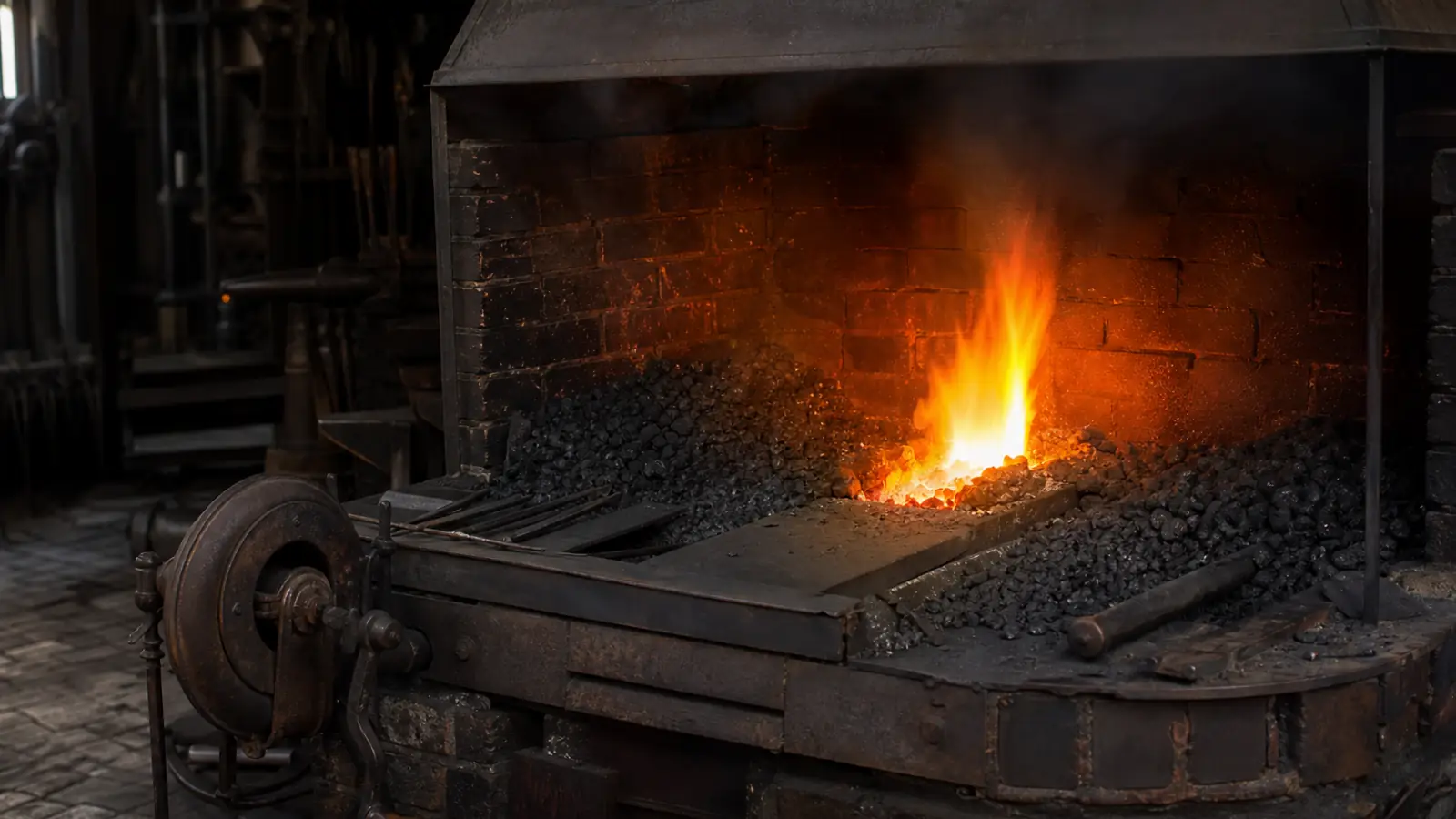
A coal or coke forge does the opposite: it builds one concentrated, very hot fire in a firepot, and you push steel into the sweet spot. That localized heat is intense - forge welding is arguably easier in coal - and you can heat one small section of a large bar without heating the rest. The trade-off is that you are constantly managing the fire: feeding fuel, controlling air from the blower, and clearing clinker and ash.
| Factor | Propane gas forge | Coal / coke forge |
|---|---|---|
| Heat pattern | Even chamber heat, easy to hold | Fierce, concentrated spot heat |
| Max temperature | To ~2300F; welds with double burner | Very hot; forge welds easily |
| Running cost | Ongoing propane; predictable | Cheap fuel if you can source it |
| Cleanliness | Clean, very low smoke | Smoky, sooty, ash and clinker |
| Learning curve | Low - light and go | Higher - fire management skill |
| Stock size | Limited by chamber opening | Any size or shape |
| Portability | Very portable, packs away | Heavier, mostly a fixed setup |
| Neighbors | Usually fine in a suburb | Smoke can trigger complaints |
Beginner propane forges worth a look
Both of these are propane forges, and either makes a solid first buy. Pick a single-burner if you mostly make knives and want the smallest gas bill; step up to a double-burner for a longer chamber and more reliable forge-welding heat.
Compact single-burner propane forge
14 x 8 x 8 in shell
- BTU/hr
- 90,000
- Burners
- 1
- Chamber (in)
- 9 x 4.5 x 3
- Weight
- 22 lb
- Regulator
- 0-20 PSI
- Firebrick
- Included
Good first forge for knives and small stock. Confirm the interior length fits your longest workpiece before buying.
Long single-burner knife forge
18 x 8 x 8 in shell
- BTU/hr
- 100,000
- Burners
- 1
- Chamber (in)
- 12 x 4.5 x 3
- Weight
- 27 lb
- Regulator
- 0-30 PSI
- Firebrick
- Included
Longer chamber suits blade work. Ships with a 0-30 PSI regulator on most listings - verify the range.
Economy single-burner forge
12 x 7 x 7 in shell
- BTU/hr
- 80,000
- Burners
- 1
- Chamber (in)
- 8 x 4 x 3
- Weight
- 18 lb
- Regulator
- 0-20 PSI
- Firebrick
- Included
Lowest-cost entry option. Interior is short - fine for hooks and small knives, tight for anything long.
Single-burner farrier-style forge (open ends)
15 x 8 x 8 in shell
- BTU/hr
- 95,000
- Burners
- 1
- Chamber (in)
- 10 x 5 x 3
- Weight
- 24 lb
- Regulator
- 0-20 PSI
- Firebrick
- Included
Open front and back let you pass long bar through. Open ends waste some heat - plan for a firebrick baffle.
Single-burner forge with front door
16 x 9 x 9 in shell
- BTU/hr
- 110,000
- Burners
- 1
- Chamber (in)
- 9 x 5 x 3.5
- Weight
- 26 lb
- Regulator
- 0-30 PSI
- Firebrick
- Included
Front door helps hold welding heat. Confirm whether a 0-30 PSI regulator is included for forge-welding pressure.
Standard double-burner propane forge
24 x 9 x 9 in shell
- BTU/hr
- 170,000
- Burners
- 2
- Chamber (in)
- 18 x 5 x 3.5
- Weight
- 34 lb
- Regulator
- 0-20 PSI
- Firebrick
- Included
All-round two-burner forge. Reaches welding heat but burns roughly twice the gas of a single burner.
Double-burner blade forge
26 x 9 x 9 in shell
- BTU/hr
- 180,000
- Burners
- 2
- Chamber (in)
- 20 x 5 x 3
- Weight
- 38 lb
- Regulator
- 0-30 PSI
- Firebrick
- Included
Long, low chamber aimed at blades and damascus billets. Verify the 0-30 PSI regulator for welding heat.
Large double-burner forge
26 x 10 x 10 in shell
- BTU/hr
- 200,000
- Burners
- 2
- Chamber (in)
- 19 x 6 x 4
- Weight
- 42 lb
- Regulator
- 0-30 PSI
- Firebrick
- Included
Big interior for tongs, hammers and heavier stock. Needs a 30 or 40 lb tank to avoid regulator freeze-up.
Double-burner forge (horizontal/vertical)
22 x 9 x 9 in shell
- BTU/hr
- 175,000
- Burners
- 2
- Chamber (in)
- 16 x 5.5 x 4
- Weight
- 40 lb
- Regulator
- 0-30 PSI
- Firebrick
- Included
Can stand vertically for hardening long blades. Vertical use changes heat pattern - read the manual.
What propane actually costs to run
The one place coal can genuinely win is fuel cost, so it is worth understanding what gas really burns. Propane holds about 21,548 BTU per pound, so a full 20 lb tank stores roughly 430,000 BTU. A single-burner forge sipping around 90,000 BTU/hr will run several hours on a tank; a double-burner at roughly 180,000 BTU/hr can drain one in a little over two hours of continuous use.
Refill cost varies by region, so rather than trust a number someone quoted online, plug your burner size, run time, and local propane price into the propane forge cost calculator. For most hobbyists forging a few hours a week, propane is a very manageable running cost, and the convenience usually outweighs the fuel savings coal offers - unless you are forging many hours every day.
When a coal or coke forge is the right call
Coal is not just for traditionalists. A coal forge for beginners makes real sense if:
- You want to forge long or oddly shaped stock that will never fit inside a gas chamber.
- You have a cheap, reliable fuel source nearby (smithing coal, coke, or lump charcoal in a pinch).
- You are working in an open shop or on rural property where smoke will not upset anyone.
- You specifically want to learn fire management and forge welding in solid fuel.
The heat a good firepot delivers is hard to beat for heavy work, and the fuel can cost less per hour than propane if you source it well. Just budget for a blower, a firepot or brake-drum build, and somewhere to store dirty fuel. And know that a smoky fire in a suburban backyard is the fastest way to a neighbor complaint.
Pitfalls before you buy either
A few things trip up first-time buyers on both sides.
- Chamber size on a gas forge. Measure your intended projects. A compact single-burner is great for knives but frustrating if you want to bend a fireplace poker. Check the opening height, not just the length.
- Propane supply and tank freeze. A hungry double-burner can outrun a 20 lb tank in cold weather - the tank frosts over and pressure drops. Sizing up the tank or drawing from two tanks fixes it. See propane tank sizes for forges.
- Coal quality. Cheap hardware-store coal is often high-sulfur and smoky. Real smithing coal or coke burns cleaner and hotter, but you have to find a supplier.
- Ventilation for both. Every forge, gas or solid fuel, produces carbon monoxide. Neither is safe in a closed garage.
If you are still torn between the two propane options, the single vs double burner comparison breaks down the gas trade-off in detail.
The bottom line
For the vast majority of beginners in the US, start with propane. A gas forge blacksmith setup gets you forging on day one, holds temperature while you practice hammer control, runs clean enough for a garage with the door open to the driveway, and packs away when you are done. You can always add a coal forge later, once you know what kind of work you love and whether you have the space and fuel for it.
If you already know you want to move big stock, weld heavily in solid fuel, or you have cheap coal and an open shop, a coal forge is a legitimate first forge - just go in expecting a steeper learning curve. Either way, run the gas numbers first with the propane forge cost calculator.
Frequently asked questions
Is a propane forge or coal forge better for beginners?
For most beginners, a propane forge wins. A gas forge lights instantly, holds a steady heat, runs clean, and is portable, which lets you focus on hammer control instead of fire management. A coal forge for beginners is workable and delivers fierce localized heat, but it is smoky, needs fuel sourcing, and has a steeper learning curve. Start with propane unless you specifically need large-stock capacity or already have cheap coal.
Can a propane forge get hot enough to forge weld?
Yes, though it depends on the forge. A single-burner propane gas forge reaches bright forging heat easily and can sometimes weld with the right flux and technique, but it is marginal. A double-burner forge, running about 170,000-200,000 BTU with a longer, hotter chamber, reaches forge-welding temperature more reliably. Coal still makes welding a little easier thanks to its concentrated fire, but plenty of smiths weld happily in gas.
Is a gas forge cheaper to run than coal?
Sometimes. Coal or coke fuel can cost less per hour than propane if you have a good local supplier, which is the main cost argument for solid fuel. But a gas forge blacksmith setup wins on convenience and cleanliness. Rather than guess, estimate your gas bill from your burner size and local propane price with the propane forge cost calculator. For a few hours a week, propane is usually very affordable.
Do I need ventilation for a propane forge indoors?
Never run any forge in a fully closed space. A propane gas forge produces carbon monoxide and consumes oxygen, so forge outdoors or in a well-ventilated area with the door open, use a CO detector, and leak-test connections with soapy water. Coal forges add smoke on top of CO and really need a chimney or open-air setup. Both demand real ventilation - this is not optional.
Can I forge any size of steel in a propane forge?
No. A propane forge only heats what fits inside its chamber, so a compact single-burner is limited to knife-length and small stock. A longer double-burner helps, but you still cannot heat a huge bar or an oddly shaped piece the way an open coal fire can. If moving large or unusual stock is your main goal, a coal forge or a larger custom gas forge is the better fit.
Last verified 2026-06. Specs, sizes and market prices change - confirm details on the retailer page before buying.