The Best Propane Forge for Beginners
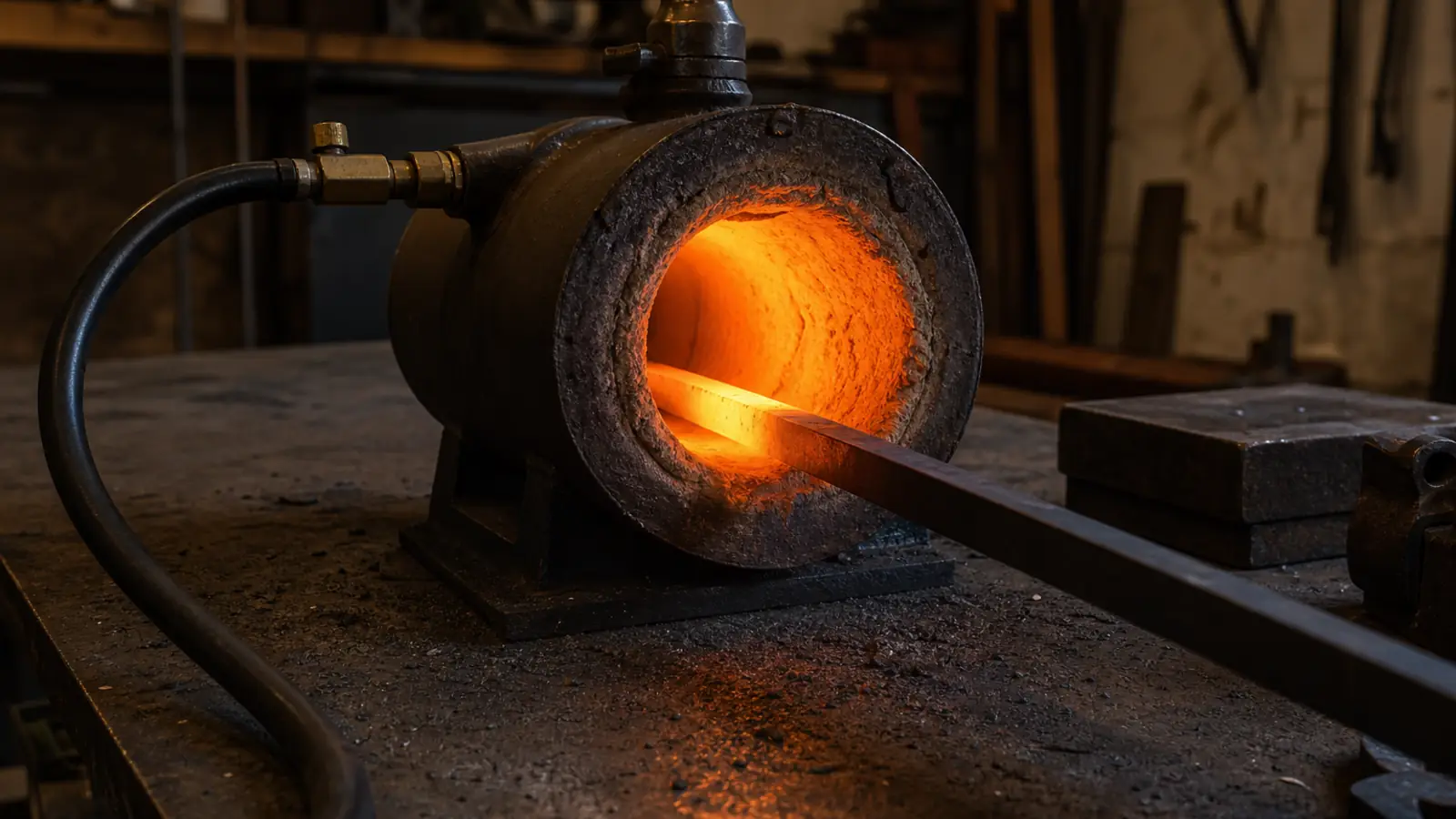
Quick answer
For most beginners, a single-burner propane forge (~80-110k BTU) is the right first forge: it heats fast, sips gas from one 20 lb tank, and suits knives, hooks, and small stock. Step up to a double burner only if you plan to heat longer bars or reach forge-welding temperature.
What actually matters in a first forge
Most "best propane forge" lists rank a dozen boxes by brand. That is not how a beginner should choose. A first forge is a simple insulated box with a burner, and the specs that decide whether you enjoy it or fight it are boring but concrete: how long a bar you can fit inside, whether the burner and regulator can push to your target temperature, and whether the interior is actually protected from flux and scale.
Work through four questions in order and the field narrows fast:
- Chamber length vs your stock. Measure the longest bar you realistically want to heat, then confirm the forge opening and interior length let it pass through with the middle sitting in the hot zone. A pass-through (open both ends) is worth a lot here.
- Single or double burner. One burner is enough for knives and small work and is cheaper to run. Two burners give a longer even heat and reach forge-welding temperature.
- Regulator range. A 0-20 PSI regulator handles general forging. If you want to weld, you want headroom to run harder, which usually means a 0-30 PSI regulator.
- Insulation and coating. Ceramic fiber blanket alone is not a finished floor. Look for included firebrick and, ideally, a rigidizer plus a refractory or IR coating, or plan to add them.
Single vs double burner: the real decision
This is the choice that trips up most first-time buyers, so be honest about your projects. A single-burner forge in the ~80-110k BTU range heats a compact chamber quickly and runs comfortably off one 20 lb propane tank. That tank can continuously supply roughly 80,000 BTU/hr at 60F when about half full, which lines up neatly with a single burner. For knives, hooks, bottle openers, punches, and drawing out small stock, it is the default beginner pick.
A double-burner forge (~170-200k BTU) buys you a longer, more even hot zone and enough energy to reach forge-welding heat. The tradeoffs are real: it burns close to twice the gas, and its BTU appetite can outrun a single 20 lb tank's vaporization rate, especially in cold weather when that rate roughly halves. Many double-burner owners end up running a larger tank or a two-tank manifold so the cylinder does not frost up and starve the burners. Step up to a double burner if you already know you want to forge weld, work longer bars, or heat several pieces at once, not just because bigger sounds better.
| Spec | Single burner | Double burner |
|---|---|---|
| Typical BTU | ~80-110k | ~170-200k |
| Chamber | Short, compact | Longer, even heat |
| Gas use | ~1x | ~2x |
| Welding heat | Marginal | Yes, with headroom |
| Best for | Knives, small stock | Long bars, welding |
Cost to run, before you buy
Gas is an ongoing cost, and a double burner roughly doubles it. Before committing, it helps to translate BTU into dollars per hour for the forge you are considering. A 20 lb tank holds about 430,960 BTU of propane (propane is ~21,548 BTU/lb), so a forge pulling 90k BTU/hr will drain a tank in well under five hours of continuous running. Estimate this for both a single and double burner and the ownership picture gets a lot clearer.
Estimate your forge's cost per hour
Beginner forge picks by use-case
Two categories cover almost every beginner. Choose the single burner unless a specific project genuinely requires the double. The site pulls current specs and links automatically; the choice below is about matching the type to your work, not chasing a brand.
Compact single-burner propane forge
14 x 8 x 8 in shell
- BTU/hr
- 90,000
- Burners
- 1
- Chamber (in)
- 9 x 4.5 x 3
- Weight
- 22 lb
- Regulator
- 0-20 PSI
- Firebrick
- Included
Good first forge for knives and small stock. Confirm the interior length fits your longest workpiece before buying.
Long single-burner knife forge
18 x 8 x 8 in shell
- BTU/hr
- 100,000
- Burners
- 1
- Chamber (in)
- 12 x 4.5 x 3
- Weight
- 27 lb
- Regulator
- 0-30 PSI
- Firebrick
- Included
Longer chamber suits blade work. Ships with a 0-30 PSI regulator on most listings - verify the range.
Economy single-burner forge
12 x 7 x 7 in shell
- BTU/hr
- 80,000
- Burners
- 1
- Chamber (in)
- 8 x 4 x 3
- Weight
- 18 lb
- Regulator
- 0-20 PSI
- Firebrick
- Included
Lowest-cost entry option. Interior is short - fine for hooks and small knives, tight for anything long.
Single-burner farrier-style forge (open ends)
15 x 8 x 8 in shell
- BTU/hr
- 95,000
- Burners
- 1
- Chamber (in)
- 10 x 5 x 3
- Weight
- 24 lb
- Regulator
- 0-20 PSI
- Firebrick
- Included
Open front and back let you pass long bar through. Open ends waste some heat - plan for a firebrick baffle.
Single-burner forge with front door
16 x 9 x 9 in shell
- BTU/hr
- 110,000
- Burners
- 1
- Chamber (in)
- 9 x 5 x 3.5
- Weight
- 26 lb
- Regulator
- 0-30 PSI
- Firebrick
- Included
Front door helps hold welding heat. Confirm whether a 0-30 PSI regulator is included for forge-welding pressure.
Standard double-burner propane forge
24 x 9 x 9 in shell
- BTU/hr
- 170,000
- Burners
- 2
- Chamber (in)
- 18 x 5 x 3.5
- Weight
- 34 lb
- Regulator
- 0-20 PSI
- Firebrick
- Included
All-round two-burner forge. Reaches welding heat but burns roughly twice the gas of a single burner.
Double-burner blade forge
26 x 9 x 9 in shell
- BTU/hr
- 180,000
- Burners
- 2
- Chamber (in)
- 20 x 5 x 3
- Weight
- 38 lb
- Regulator
- 0-30 PSI
- Firebrick
- Included
Long, low chamber aimed at blades and damascus billets. Verify the 0-30 PSI regulator for welding heat.
Large double-burner forge
26 x 10 x 10 in shell
- BTU/hr
- 200,000
- Burners
- 2
- Chamber (in)
- 19 x 6 x 4
- Weight
- 42 lb
- Regulator
- 0-30 PSI
- Firebrick
- Included
Big interior for tongs, hammers and heavier stock. Needs a 30 or 40 lb tank to avoid regulator freeze-up.
Double-burner forge (horizontal/vertical)
22 x 9 x 9 in shell
- BTU/hr
- 175,000
- Burners
- 2
- Chamber (in)
- 16 x 5.5 x 4
- Weight
- 40 lb
- Regulator
- 0-30 PSI
- Firebrick
- Included
Can stand vertically for hardening long blades. Vertical use changes heat pattern - read the manual.
How to match a forge to your stock and space
Chamber size is where beginners most often regret a purchase. A forge that is perfect for 4-inch knife blanks becomes frustrating the moment you try to put a gentle curve in a 12-inch fireplace poker. Before you buy, do this:
- Measure the longest piece you want to heat and the length that needs to be hot at once.
- Confirm the forge is a pass-through design if your stock is longer than the chamber, so the bar can slide through and you heat the middle.
- Remember that firebrick doors and floors shrink the usable interior; the advertised chamber and the working chamber are not always the same.
Also think about where you will run it. A propane forge belongs outdoors or under a well-ventilated open structure, never in a closed garage or basement. If your only workspace is enclosed, factor in a way to run it in a doorway or open bay before you spend anything.
Common first-forge pitfalls
A few mistakes show up again and again in beginner forums:
- Buying the biggest forge you can afford. More chamber means more gas to heat empty space. A right-sized single burner reaches temperature faster and costs less to run.
- Ignoring the regulator. A forge sold with a fixed low-pressure regulator may never reach the heat you want. Confirm the range, and prefer an adjustable 0-20 or 0-30 PSI regulator.
- Assuming the interior is finished. Bare ceramic fiber blanket sheds fibers and erodes under flux. Plan on rigidizer and a refractory or IR coating, and a firebrick floor, even if you add them yourself.
- Forgetting shipping and tank realities. Forges ship heavy, and the tank, hose, and regulator may be sold separately. Budget for the complete gas train, not just the box.
Frequently asked questions
Is a single-burner or double-burner propane forge better for a beginner?
For most beginners, a single-burner propane forge is the better first forge. It heats a compact chamber fast, runs comfortably off one 20 lb tank at around 80-110k BTU, and handles knives, hooks, and small stock. Choose a double burner only if you already know you want to forge weld or heat long bars, since it burns roughly twice the gas.
What size propane forge do I need for blacksmithing?
Size the forge to your longest common workpiece, not to the biggest box you can afford. A compact single-burner chamber suits knives and small stock and wastes less gas heating empty space. If you plan to work 12-inch or longer bars, prioritize a pass-through design so you can slide stock through and heat the middle section evenly.
Can a beginner propane forge reach forge-welding temperature?
Some single burners get marginally there, but reliable forge welding is easier with a double burner and enough regulator headroom. Most carbon and tool steels forge around 1500-2100F, while welding runs hotter. If welding is a near-term goal, favor a double burner with a 0-30 PSI regulator rather than trying to push an underpowered single burner.
Do I need a special regulator for a propane forge?
Yes, forges use an adjustable high-pressure regulator, typically 0-20 or 0-30 PSI, not the low-pressure regulator on a gas grill. A 0-20 PSI unit handles general forging; a 0-30 PSI unit gives headroom for welding heat. Confirm the regulator range before buying, since a forge that cannot run hard enough will limit what steel you can move.
How much does it cost to run a propane forge?
Propane holds about 21,548 BTU/lb, so a 20 lb tank stores roughly 430,960 BTU. A single burner around 90k BTU/hr drains a tank in under five hours of continuous running; a double burner roughly doubles that gas use. Estimate dollars per hour for your specific forge with the cost calculator before you commit.
Can I run a propane forge in my garage?
Not in a closed garage or basement. A propane forge produces carbon monoxide and needs to run outdoors or under a well-ventilated open structure, following NFPA 58 guidance for LP gas. Use a CO detector, leak-test connections with soapy water, and store cylinders outside. If your only space is enclosed, plan to run the forge in an open doorway or bay.
Last verified 2026-06. Specs, sizes and market prices change - confirm details on the retailer page before buying.