The Best Portable Propane Forge for Small Spaces
Quick answer
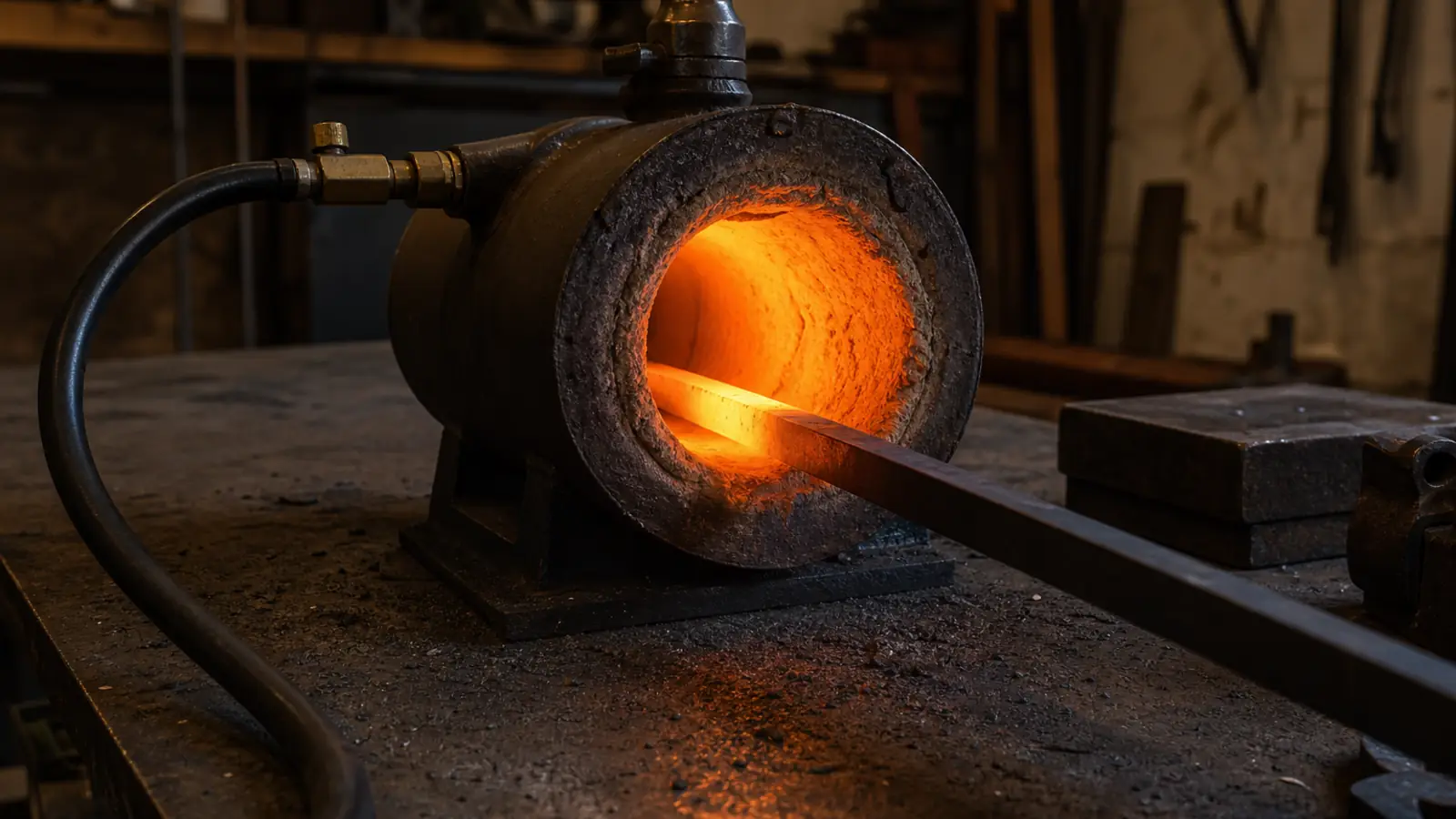
A portable propane forge is a light, single-burner unit with a self-contained regulator and a small insulated chamber you can carry and pack away. Look for at least 6 inches of usable interior, a 0-30 psi regulator, and stable footing. Portable means small footprint, not indoor-safe: always run it outdoors or in a wide-open, ventilated space.
What makes a propane forge portable
A portable propane forge is a small, light unit you can carry to a demo, a friend's driveway, or a corner of a one-car garage, then pack away when you are done. In practice that means a single burner, a compact insulated chamber, and a self-contained regulator and hose so the whole rig travels as one kit.
The trade-off is size. You gain a small footprint and fast setup, and you give up interior length and heat reserve. For a beginner working small stock, that is often a smart trade. This page focuses on portability and footprint, not the full field of first forges. If you want an all-around starter that lives in one spot, start with our beginner forge picks instead, then come back here if travel and small size are the priority.
Compact forges and burners to start with
For portability, a single-burner forge is the natural pick: one burner, less mass to carry, and lower propane draw. Pair it with a quality atmospheric burner if you are building or upgrading a small forge body of your own. Both types below stay light and self-contained, which is what makes setup and teardown quick.
Compact single-burner propane forge
14 x 8 x 8 in shell
- BTU/hr
- 90,000
- Burners
- 1
- Chamber (in)
- 9 x 4.5 x 3
- Weight
- 22 lb
- Regulator
- 0-20 PSI
- Firebrick
- Included
Good first forge for knives and small stock. Confirm the interior length fits your longest workpiece before buying.
Long single-burner knife forge
18 x 8 x 8 in shell
- BTU/hr
- 100,000
- Burners
- 1
- Chamber (in)
- 12 x 4.5 x 3
- Weight
- 27 lb
- Regulator
- 0-30 PSI
- Firebrick
- Included
Longer chamber suits blade work. Ships with a 0-30 PSI regulator on most listings - verify the range.
Economy single-burner forge
12 x 7 x 7 in shell
- BTU/hr
- 80,000
- Burners
- 1
- Chamber (in)
- 8 x 4 x 3
- Weight
- 18 lb
- Regulator
- 0-20 PSI
- Firebrick
- Included
Lowest-cost entry option. Interior is short - fine for hooks and small knives, tight for anything long.
Single-burner farrier-style forge (open ends)
15 x 8 x 8 in shell
- BTU/hr
- 95,000
- Burners
- 1
- Chamber (in)
- 10 x 5 x 3
- Weight
- 24 lb
- Regulator
- 0-20 PSI
- Firebrick
- Included
Open front and back let you pass long bar through. Open ends waste some heat - plan for a firebrick baffle.
Single-burner forge with front door
16 x 9 x 9 in shell
- BTU/hr
- 110,000
- Burners
- 1
- Chamber (in)
- 9 x 5 x 3.5
- Weight
- 26 lb
- Regulator
- 0-30 PSI
- Firebrick
- Included
Front door helps hold welding heat. Confirm whether a 0-30 PSI regulator is included for forge-welding pressure.
3/4 in naturally-aspirated forge burner
3/4 in
- BTU/hr
- 90,000
- Burners
- 1
- Regulator
- 0-30 PSI
Heats roughly 300-350 cu in of chamber. The default single-burner size for a first forge. Needs a 0-20 or 0-30 PSI regulator.
1 in high-output forge burner
1 in
- BTU/hr
- 150,000
- Burners
- 1
- Regulator
- 0-30 PSI
Feeds a larger chamber (up to ~700 cu in) or reaches welding heat. Hungrier - pair with a 30/40 lb tank to avoid freeze-up.
Blown (ribbon) forge burner
forced-air
- BTU/hr
- 120,000
- Burners
- 1
- Regulator
- 0-30 PSI
A fan feeds air for even, controllable heat and easy welding, but needs power and more setup than a naturally-aspirated burner.
| Factor | Portable single-burner | Full-size / double-burner |
|---|---|---|
| Usable interior | ~6-8 in (15-20 cm) | ~10-16 in (25-40 cm) |
| Weight | ~15-25 lb (7-11 kg) | ~35-60+ lb (16-27+ kg) |
| Burners | One | Two or more |
| Best stock | Hooks, small blades, billets to ~6 in | Longer bars, tongs, larger billets |
| Propane draw | Lower per hour | Higher per hour |
| Heat recovery | Slower with the door open | Faster, more reserve |
| Setup / teardown | Grab-and-go kit | Semi-permanent |
Chamber size vs the stock you can actually forge
The single biggest limit on a small forge is usable interior length, and it is easy to underestimate. A compact single-burner forge typically gives about 6 to 8 inches (15 to 20 cm) of open chamber. That comfortably handles hooks, bottle openers, small blades, punches, and short billets. It gets awkward the moment you need to pass a longer bar through, because the ends chill fast outside the hot zone.
Heat output tracks with chamber size, too. A single 3/4 inch burner puts out roughly 90,000 BTU/hr and heats about 350 cubic inches of chamber, which is a good match for a small forge. Push the interior much bigger and one burner struggles to hold welding heat. If you are torn between one burner and two, our single vs double burner comparison lays out the trade, and the burner BTU calculator helps you size a burner to a chamber before you spend money.
Propane economy and heat recovery
Small forges sip less propane than big ones simply because there is less volume to heat. A single burner on a compact chamber runs comfortably on a standard 20 lb (9 kg) grill tank for a few hours, which is part of what makes these units travel-friendly. The catch in cold weather is tank frost: a small tank can ice up and lose pressure during a long session, so a 30 or 40 lb tank is worth it if you forge outdoors in winter. Our propane tank size guide covers the run-time math.
Heat recovery is the honest downside. A small chamber loses temperature quickly every time you open the door, and one burner has less reserve to claw it back. You learn to work in shorter heats and keep the door mostly closed. Tuning the flame neutral to slightly reducing helps it run efficiently and controls scale; see how to tune a propane forge burner for the specifics.
Setup, teardown, and stable footing
The appeal of a portable forge is that it becomes a grab-and-go kit: forge body, burner, hose, and regulator that connect in a couple of minutes. Keep the parts together in a bin so nothing wanders off between sessions. Before you light it, always leak-test the fittings with soapy water and watch for bubbles at the connections.
Footing matters more with a light forge than a heavy one. Set it on a level, non-combustible surface such as a steel stand, a concrete slab, or a paver, never on wood, plastic, or grass. A lightweight forge can shift when you drag hot stock against the door, so make sure the feet sit flat and the propane tank stands upright behind or beside you, clear of the flame and the hose path. If the rig feels tippy, add ballast or clamp it to your bench before the first heat.
Frequently asked questions
Can I use a portable propane forge indoors?
No. Portable means easy to move, not safe for enclosed spaces. Any propane forge produces carbon monoxide and needs real airflow. Run it outdoors or in a wide-open garage with the door up and a fan moving air, keep a CO detector nearby, and never fire it in a closed room, shed, or tent. Portability is about footprint, not ventilation.
How small is too small for a portable forge?
For beginners, look for at least 6 inches (15 cm) of usable interior length. Anything shorter limits you to tiny hooks and short billets, and it fights you the moment stock needs to pass through. A single-burner unit with roughly 6 to 8 inches of chamber handles most beginner projects while staying light enough to carry to a demo or a driveway.
Will a single burner get hot enough to forge weld?
A well-tuned atmospheric single burner reaches forging heat (yellow, ~2000-2300F / 1093-1260C) easily and can reach welding heat in a small, tight chamber, though it is less forgiving than a blown setup. Welding needs even heat and clean flux, which are harder in a big loose chamber. Keep the interior small and the flame neutral to slightly reducing.
What propane tank should I use with a portable forge?
A standard 20 lb (9 kg) grill tank runs a single burner for a few hours and is easy to carry, which suits travel and demos. In cold weather a small tank can frost over and lose pressure, so a larger 30 or 40 lb tank helps on long sessions. See our guide on propane tank sizes for forges for the trade-offs.
Does a portable forge come with a regulator?
Many compact kits include a hose and an adjustable 0-30 psi regulator, but confirm before buying. A self-contained regulator is what makes a unit truly grab-and-go. If yours does not include one, budget for a matched hose and regulator rather than reusing a low-pressure grill regulator, which cannot supply the pressure a forge burner needs.
How do I keep a lightweight forge from tipping over?
Set it on a level, non-combustible surface like a steel stand, a paver, or concrete, never on wood or grass. A light forge can shift when you pull hot stock against the door, so check that the feet sit flat and the tank stands upright behind or beside you, not under the hose. Add weight or clamp the forge to a bench if it feels tippy.
Last verified 2026-06. Specs, sizes and market prices change - confirm details on the retailer page before buying.