VEVOR Propane Forge Review: What the Specs Actually Tell You
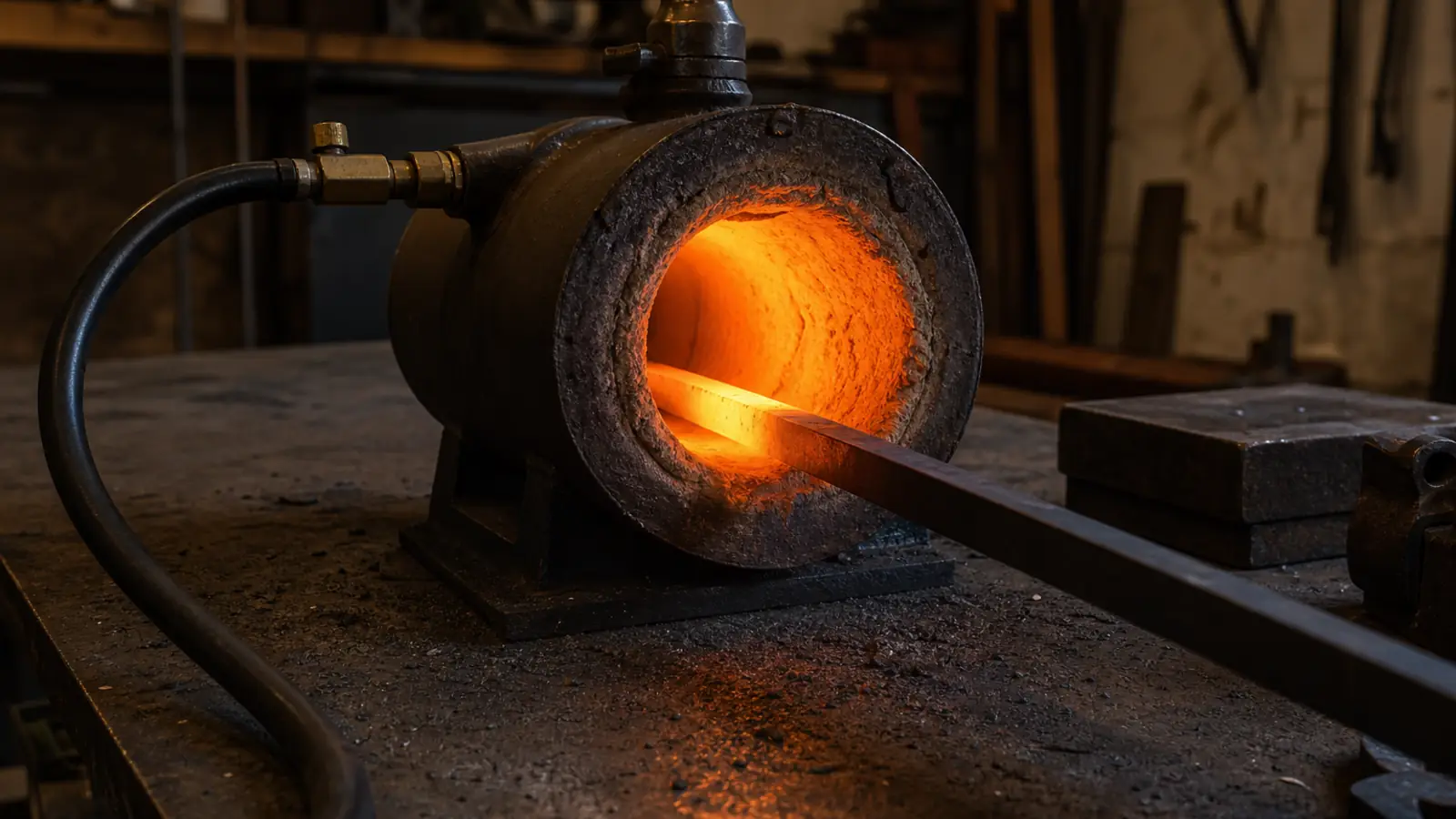
Quick answer
VEVOR propane forges are budget, imported single- and double-burner units that publish competitive BTU numbers and usually include a burner, ceramic-fiber liner, firebrick, and a low-pressure regulator. They can serve beginners well for the price, but the included 0-20 PSI regulator limits forge-welding heat and quality control varies unit to unit, so verify the current listing before buying.
What VEVOR actually sells
VEVOR is a budget house brand that sells a rotating catalog of imported tools, including propane forges aimed squarely at hobbyists and beginners. You will typically find two families: a compact single-burner forge advertised around 80,000-110,000 BTU, and a longer double-burner model advertised higher. Listings change often, model numbers get reused, and the photos do not always match the box - which is the single most important thing to understand before you spend money.
Most VEVOR forges ship as a near-complete kit: the forge body, one or two burners, a ceramic-fiber (kaowool-style) blanket liner, one or more firebricks, and a low-pressure propane regulator with a hose. That bundle is a big part of the appeal, since a name-brand forge plus a separate regulator and hose can cost noticeably more. The trade-off is consistency: because these are mass-produced and drop-shipped, two buyers can receive units that differ in fit, finish, and how well the burner is tuned out of the box.
Reading the spec sheet: BTU, burners, and chamber
The headline number on any forge listing is BTU per hour, and it is worth reading skeptically. Advertised BTU describes the burner's maximum gas throughput, not how hot your workpiece gets. Real forging heat depends on chamber volume, insulation, how well the burner is tuned, ambient temperature, and your propane supply. A single-burner VEVOR with a small chamber will reach bright orange to yellow forging heat (roughly 1,500-2,100F / 815-1,150C) for knives, hooks, and small stock. The double-burner models have a longer chamber and enough burner to approach forge-welding temperatures, but they also burn close to twice the gas.
Chamber size is the spec that quietly decides what you can build. A short single-burner chamber is efficient and cheap to run but limits bar length and how you position work; a longer double-burner chamber heats more steel at once and lets you work a longer section, at the cost of gas and warm-up time. Match the chamber to the projects you actually plan to start with - most beginners are better served by a smaller, cheaper-to-run single burner. Our single vs double burner comparison walks through that trade-off in detail.
| Spec | Single burner | Double burner |
|---|---|---|
| Advertised BTU | ~80-110k | ~170-200k |
| Best for | Knives, small stock | Longer bars, welding heat |
| Gas use | Lower | ~2x single |
| Warm-up | Faster | Slower |
| Beginner fit | Strong | If you need the length |
Forges and a regulator worth pairing
If a VEVOR forge fits your budget, these are the categories to compare it against - and the regulator upgrade most single-burner kits benefit from once forge welding is on the table.
Compact single-burner propane forge
14 x 8 x 8 in shell
- BTU/hr
- 90,000
- Burners
- 1
- Chamber (in)
- 9 x 4.5 x 3
- Weight
- 22 lb
- Regulator
- 0-20 PSI
- Firebrick
- Included
Good first forge for knives and small stock. Confirm the interior length fits your longest workpiece before buying.
Long single-burner knife forge
18 x 8 x 8 in shell
- BTU/hr
- 100,000
- Burners
- 1
- Chamber (in)
- 12 x 4.5 x 3
- Weight
- 27 lb
- Regulator
- 0-30 PSI
- Firebrick
- Included
Longer chamber suits blade work. Ships with a 0-30 PSI regulator on most listings - verify the range.
Economy single-burner forge
12 x 7 x 7 in shell
- BTU/hr
- 80,000
- Burners
- 1
- Chamber (in)
- 8 x 4 x 3
- Weight
- 18 lb
- Regulator
- 0-20 PSI
- Firebrick
- Included
Lowest-cost entry option. Interior is short - fine for hooks and small knives, tight for anything long.
Single-burner farrier-style forge (open ends)
15 x 8 x 8 in shell
- BTU/hr
- 95,000
- Burners
- 1
- Chamber (in)
- 10 x 5 x 3
- Weight
- 24 lb
- Regulator
- 0-20 PSI
- Firebrick
- Included
Open front and back let you pass long bar through. Open ends waste some heat - plan for a firebrick baffle.
Single-burner forge with front door
16 x 9 x 9 in shell
- BTU/hr
- 110,000
- Burners
- 1
- Chamber (in)
- 9 x 5 x 3.5
- Weight
- 26 lb
- Regulator
- 0-30 PSI
- Firebrick
- Included
Front door helps hold welding heat. Confirm whether a 0-30 PSI regulator is included for forge-welding pressure.
Standard double-burner propane forge
24 x 9 x 9 in shell
- BTU/hr
- 170,000
- Burners
- 2
- Chamber (in)
- 18 x 5 x 3.5
- Weight
- 34 lb
- Regulator
- 0-20 PSI
- Firebrick
- Included
All-round two-burner forge. Reaches welding heat but burns roughly twice the gas of a single burner.
Double-burner blade forge
26 x 9 x 9 in shell
- BTU/hr
- 180,000
- Burners
- 2
- Chamber (in)
- 20 x 5 x 3
- Weight
- 38 lb
- Regulator
- 0-30 PSI
- Firebrick
- Included
Long, low chamber aimed at blades and damascus billets. Verify the 0-30 PSI regulator for welding heat.
Large double-burner forge
26 x 10 x 10 in shell
- BTU/hr
- 200,000
- Burners
- 2
- Chamber (in)
- 19 x 6 x 4
- Weight
- 42 lb
- Regulator
- 0-30 PSI
- Firebrick
- Included
Big interior for tongs, hammers and heavier stock. Needs a 30 or 40 lb tank to avoid regulator freeze-up.
Double-burner forge (horizontal/vertical)
22 x 9 x 9 in shell
- BTU/hr
- 175,000
- Burners
- 2
- Chamber (in)
- 16 x 5.5 x 4
- Weight
- 40 lb
- Regulator
- 0-30 PSI
- Firebrick
- Included
Can stand vertically for hardening long blades. Vertical use changes heat pattern - read the manual.
Adjustable propane regulator 0-30 PSI
POL/QCC-1 fitting
- Regulator
- 0-30 PSI
0-30 PSI range reaches forge-welding pressure. Confirm the tank fitting (QCC-1) matches your tank.
Adjustable propane regulator 0-20 PSI
POL/QCC-1 fitting
- Regulator
- 0-20 PSI
Fine for general forging heat. If you plan to forge-weld, choose the 0-30 PSI version instead.
The regulator question (and forge welding)
The included regulator is where budget forge kits most often fall short for ambitious beginners. VEVOR kits commonly ship with a fixed or low-range regulator around 0-20 PSI. For general forging - drawing out, bending, tapering, making hooks and small knives - that is genuinely enough, and many owners never need more. The limit shows up if you want to forge weld, which asks for a hotter, higher-pressure flame; a 0-20 PSI regulator can leave you just short of a reliable welding heat, especially in a double-burner chamber on a cold day.
If forge welding is on your roadmap, budget for an adjustable 0-30 PSI regulator upgrade from the start rather than fighting the stock one later. It is an inexpensive part, it swaps onto the same tank, and it gives you headroom without changing the forge. Check the current listing carefully, because VEVOR occasionally bundles a higher-range regulator - you do not want to buy a duplicate. As a plain safety note, never run more pressure than your hose and fittings are rated for.
What to verify before you buy
Because listings and revisions change, treat these as the questions to answer on the specific unit in your cart:
- Regulator range: is it 0-20 PSI or adjustable to 0-30? If you want welding heat, plan the upgrade.
- Refractory coating: the ceramic-fiber liner should be rigidized and coated with a hard refractory (a Kastolite or ITC-style product) for durability and to lock down loose fibers. VEVOR kits usually do not include rigidizer or a refractory coat - budget a little extra and a weekend to apply it.
- What is actually in the box: burner count, number of firebricks, hose length, and whether a regulator and hose are both included.
- Shipping and QC: inspect for shipping damage, a cracked liner, or a burner that arrives out of tune. Reported quality varies unit to unit, so open and check everything promptly while returns are easy.
- Your propane supply: a hungry double burner can outrun a 20 lb tank's vaporization rate and freeze it up, especially in cold weather.
So, is a VEVOR forge good?
For a first forge on a tight budget, a VEVOR single burner is a reasonable, honest choice: it will get steel to forging heat, it comes mostly complete, and it lets you start making things without a big outlay. Go in knowing what you are buying - a mass-produced budget tool with variable QC, a basic regulator, and a liner that wants a refractory coat. Verify the live listing, plan the small upgrades, and it can carry a beginner a long way. If you want a broader shortlist, see our best propane forge for beginners.
Frequently asked questions
Is the VEVOR propane forge good for beginners?
For the price, yes - a VEVOR single-burner forge reaches normal forging heat and arrives mostly complete, so a beginner can start making knives, hooks, and small stock quickly. Just expect a budget tool: variable quality control, a basic 0-20 PSI regulator, and a ceramic-fiber liner that really wants a refractory coating before heavy use.
Can a VEVOR forge reach forge-welding temperature?
A double-burner VEVOR can approach forge-welding heat, but the commonly included 0-20 PSI regulator often leaves you just short, especially in cold weather. If welding is your goal, budget an adjustable 0-30 PSI regulator upgrade from the start. A single-burner model handles general forging fine but is not the tool for consistent welding heat.
Does a VEVOR forge come with everything you need?
Most VEVOR kits include the forge body, one or two burners, a ceramic-fiber liner, firebrick, and a regulator with hose - close to complete. What is usually missing is rigidizer and a hard refractory coating for the liner, and sometimes a higher-range regulator. Always read the current listing, because contents and revisions change often.
How much does it cost to run a VEVOR propane forge?
Running cost tracks burner size and how long you forge. A single burner sips propane compared with a double, which can burn close to twice the gas. Propane holds about 21,548 BTU per pound, so a 20 lb tank is roughly 431,000 BTU total. Use our propane forge cost calculator to estimate cost per hour for your BTU and local gas price.
What should I upgrade on a VEVOR forge first?
Two cheap upgrades matter most. First, rigidize and refractory-coat the ceramic-fiber liner to protect it and lock down loose fibers. Second, if you want forge-welding heat, swap the stock regulator for an adjustable 0-30 PSI unit. Both are inexpensive, and neither requires replacing the forge itself.
Last verified 2026-06. Specs, sizes and market prices change - confirm details on the retailer page before buying.