How to Tune a Propane Forge Burner
Quick answer
Tuning a naturally-aspirated forge burner means balancing air and propane until the flame runs neutral: a short, mostly blue inner cone with little dragon's breath at the door. Adjust the air choke or shutter for the air-fuel mix and the regulator for pressure. A rich flame is soft, sooty, and makes more carbon monoxide; a lean flame is harsh and scales your steel. Always forge with ventilation and a CO detector.
What tuning a forge burner actually means
A naturally-aspirated (venturi) burner has no blower. Propane shoots through a small jet, and the fast-moving gas drags room air in through openings near the top of the burner tube. That mix travels down the tube, ignites at the flare, and heats your forge. Tuning is nothing more than getting the ratio of air to propane right, then setting a pressure that fills your forge with heat without wasting fuel.
Two controls do almost all the work: the air intake (a choke, sliding sleeve, or set screws that open and close the air holes) and the regulator pressure. Change the air and you change whether the flame is lean, neutral, or rich. Change the pressure and you change how hard the burner runs. They interact, so expect to nudge one, then the other, a few times before it settles.
Before you chase a perfect flame, make sure the burner is even sized right for your forge. An undersized burner never reaches welding heat no matter how you tune it, and an oversized one roasts a tiny chamber and wastes gas. Run your interior volume through the forge burner BTU calculator so you know the burner is in the right ballpark. If you are still choosing hardware, the best propane forge burner picks and the atmospheric vs blown burner comparison cover the trade-offs.
Reading the flame: neutral, oxidizing, and rich
Tune with the forge cold and the shop bright enough to see color, but shaded enough to read the flame. Light the burner at low pressure (around 2-5 PSI), let the forge warm for a minute or two, then look at what the flame is doing inside the chamber and at the door.
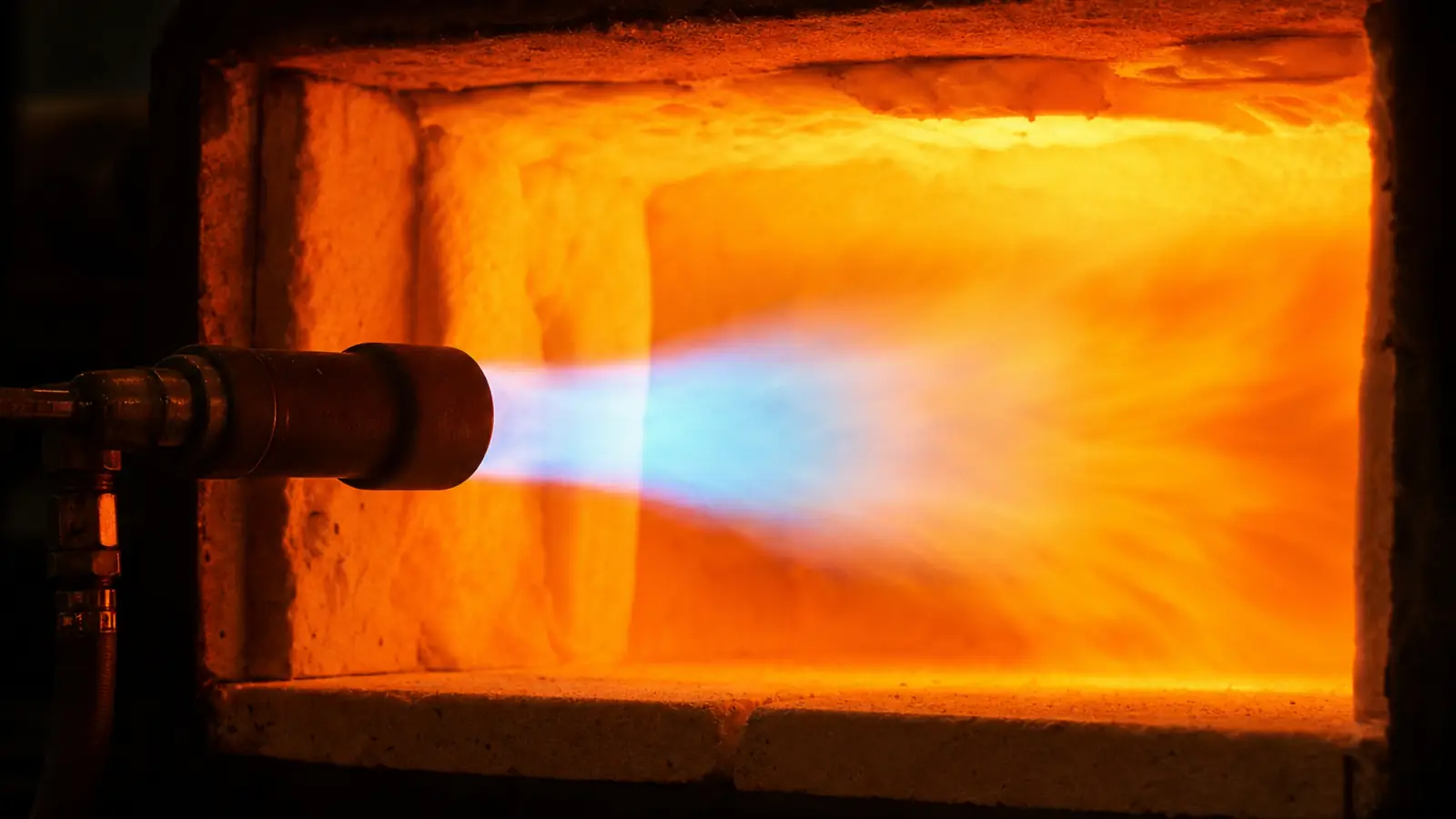
Neutral (the goal). A well-tuned burner shows a short, tight inner cone that is mostly blue, with a soft secondary flame around it. Inside a hot forge the chamber glows evenly and there is only a little pale flame licking out the door. A slightly reducing (mildly rich) flame is fine and even preferred, because a touch of extra fuel keeps oxygen off your steel and reduces scale.
Oxidizing / lean (too much air). Too much air gives a harsh, hissing, hard blue flame with a sharp roar. It runs hot but it is loaded with free oxygen, so it eats your workpiece: heavy gray scale flakes off and your stock loses more material every heat. If the flame looks angry and the steel keeps scaling badly, close the air down.
Carburizing / rich (too little air). Too little air gives a soft, lazy, yellow-tinged flame that can leave soot and produces a big lazy plume out the door, the classic 'dragon's breath.' Some dragon's breath is normal and even reassuring, but a large, unburned orange plume means fuel is finishing its burn outside the forge instead of inside it, wasting propane and pumping out more carbon monoxide. Open the air up or drop the pressure.
| Flame appearance | Diagnosis | Fix |
|---|---|---|
| Short blue cone, even glow, small door flame | Neutral / slightly reducing (good) | Leave it; this is your target |
| Harsh roar, hard blue, heavy gray scale on steel | Oxidizing / lean (too much air) | Close the air choke slightly |
| Soft yellow flame, soot, big orange plume at door | Carburizing / rich (too much fuel) | Open the air, or lower the regulator pressure |
| Very loud jet-engine roar | Air wide open and/or pressure too high | Reduce pressure; trim air toward neutral |
| Flame lifts off and floats above the flare | Gas velocity too high for the air mix | Lower pressure a little, or open air to match |
| Popping, backfiring, or flame burning up inside the tube | Flame speed exceeds gas speed | Raise pressure to relight at the flare; check the jet is clear |
| Won't reach forging heat at any setting | Burner undersized or jet clogged/misaligned | Clear the jet, re-center it, or step up burner size |
Adjusting the air choke and the regulator
Work in small steps and give the flame a few seconds to respond before you judge it.
- Set a working pressure first. For most 3/4 in and 1 in burners, forging heat lands somewhere between roughly 5 and 15 PSI. Start low and come up. If your regulator only reads to 20-30 PSI, you have plenty of range for a single-burner beginner forge. The regulator guide explains why a 0-30 PSI adjustable regulator beats a fixed one for tuning.
- Dial the air for a neutral flame. With the burner lit and warm, open or close the choke until the harsh roar softens into a steady, even flame and the dragon's breath shrinks to a small plume. If you overshoot into lazy and yellow, open the air back up a hair.
- Re-check as it heats. A cold forge and a soaking-hot forge behave differently. The mix that looked perfect on a cold start often needs a small air or pressure trim once the chamber is glowing, because a hot forge changes back-pressure at the flare.
- Lock it in. Once you find neutral, note the pressure and the choke position (a paint mark or the number of turns on a set-screw sleeve). You will get back to a good flame in seconds next session.
Burner and regulator gear for tuning
You cannot tune a mix you cannot adjust. A quality naturally-aspirated burner with a movable air choke and an adjustable 0-30 PSI regulator are the two pieces that make repeatable tuning possible. A fixed-orifice regulator or a burner with no air control leaves you fighting the flame instead of setting it.
3/4 in naturally-aspirated forge burner
3/4 in
- BTU/hr
- 90,000
- Burners
- 1
- Regulator
- 0-30 PSI
Heats roughly 300-350 cu in of chamber. The default single-burner size for a first forge. Needs a 0-20 or 0-30 PSI regulator.
1 in high-output forge burner
1 in
- BTU/hr
- 150,000
- Burners
- 1
- Regulator
- 0-30 PSI
Feeds a larger chamber (up to ~700 cu in) or reaches welding heat. Hungrier - pair with a 30/40 lb tank to avoid freeze-up.
Blown (ribbon) forge burner
forced-air
- BTU/hr
- 120,000
- Burners
- 1
- Regulator
- 0-30 PSI
A fan feeds air for even, controllable heat and easy welding, but needs power and more setup than a naturally-aspirated burner.
Adjustable propane regulator 0-30 PSI
POL/QCC-1 fitting
- Regulator
- 0-30 PSI
0-30 PSI range reaches forge-welding pressure. Confirm the tank fitting (QCC-1) matches your tank.
Adjustable propane regulator 0-20 PSI
POL/QCC-1 fitting
- Regulator
- 0-20 PSI
Fine for general forging heat. If you plan to forge-weld, choose the 0-30 PSI version instead.
Burner alignment and depth in the forge
A perfectly tuned mix still runs badly if the burner sits wrong in the shell. Alignment problems often masquerade as tuning problems, so check the mechanical setup before you keep chasing the flame.
- Depth. The burner flare should sit at or just flush with the inside face of the insulation, not poking deep into the chamber and not buried behind the wall. Too deep and the flame blows on your work and erodes the lining; too shallow and heat backs up around the tube.
- Angle. Most single-burner forges run best with the burner slightly off dead-center and angled so the flame sweeps around the inside of the chamber (a gentle swirl), rather than blasting straight down onto the workpiece or the floor. A tangential swirl heats far more evenly.
- Clearance at the door. The flame needs somewhere to go. If both ends are choked closed, pressure backs up, the flame gets lazy, and dragon's breath grows. Keep at least one opening for exhaust. If you are still assembling the forge, the build guide covers burner port placement and flare depth.
Common problems and quick fixes
Loud jet-engine roar. A hard roar usually means the air is wide open and the pressure is high. That is fine for a quick weld heat but noisy and fuel-hungry as a default. Back the pressure down and trim the air until the roar settles into a steady rush.
Flame lifts off the flare. If the flame floats above the burner and looks like it might blow out, gas velocity is too high for the amount of air being pulled in. Lower the pressure slightly, or open the air to match the fuel. A well-designed flare (a slight bell at the tube end) slows the gas and helps the flame stay anchored.
Popping or backfiring. Sharp pops, or a flame that disappears up inside the tube and burns there with a whistle, mean the flame is traveling faster than the gas. This often happens at very low pressure or during shutdown. Raise the pressure to push the burn back out to the flare, and confirm the jet is centered and clear; a partially blocked or off-axis orifice starves the venturi.
Heavy dragon's breath. A big lazy orange plume at the door is the number-one beginner worry. A small pale plume is normal. A large one means the mix is rich or the forge is over-pressured: open the air, drop the pressure a couple PSI, and make sure the exhaust opening is not blocked. Rich running matters beyond fuel waste because it produces more carbon monoxide, which is exactly why ventilation is non-negotiable. If you plan to forge weld, a slightly reducing flame is the right call, and the forge welding guide covers pairing that atmosphere with flux.
Frequently asked questions
What does a properly tuned forge burner flame look like?
A short, tight inner cone that is mostly blue, surrounded by a soft secondary flame, with the forge interior glowing evenly and only a small pale plume at the door. A slightly reducing (barely rich) flame is fine and helps keep scale off your steel. If the flame is harsh and roaring it is too lean; if it is soft, yellow, and sooty it is too rich.
Is dragon's breath from my forge dangerous?
A small pale plume at the door is normal and harmless. A large orange plume means the burner is running rich and dumping unburned fuel and extra carbon monoxide out the door. That is a fuel-efficiency and air-quality issue, not an explosion risk, but it is a real reason to forge outdoors or with strong ventilation and a CO detector. Open the air or drop the pressure to shrink it.
Do I adjust the air or the pressure first?
Set a working pressure first (start low, around 3-5 PSI, and come up), then dial the air choke to reach a neutral flame at that pressure. After that, use the regulator pressure as your main heat control day to day and only revisit the air if the flame character changes. Air controls the mix; pressure controls how hard the burner runs.
Why does my burner pop or backfire?
Popping or a flame that burns inside the tube means the flame is moving faster than the gas, usually at very low pressure or during shutdown. Raise the pressure to push the burn back out to the flare. Also check that the gas jet is centered and unclogged, since an off-axis or blocked orifice weakens the venturi and can cause backfiring and lift-off both.
What pressure should I run a naturally-aspirated forge burner at?
Most 3/4 in and 1 in atmospheric burners reach forging heat between roughly 5 and 15 PSI, depending on burner design, forge size, and outdoor temperature. Start low and raise pressure until the chamber glows evenly. If you cannot reach heat even wide open, the burner may be undersized, the jet may be clogged, or the forge may be too large for one burner.
Can I tune an atmospheric burner to forge weld?
Yes. Aim for a neutral-to-slightly-reducing flame so extra oxygen is not attacking the joint, and bring the forge to a bright yellow-white welding heat. A well-sized, well-tuned atmospheric burner can reach welding temperature, though blown burners make it easier to hold a steady welding heat. Pair the reducing atmosphere with flux and clean, scale-free stock.
Last verified 2026-06. Specs, sizes and market prices change - confirm details on the retailer page before buying.