Best Propane Forge Burner
Quick answer
For most beginners, a single 3/4 in naturally-aspirated propane burner (~90,000 BTU/hr) is the sweet spot: it heats a chamber up to about 350 cubic inches and runs on an adjustable 0-30 PSI regulator. Step up to a 1 in burner (~150,000 BTU/hr, ~700 cubic inches) only if your forge is large or you plan to forge weld.
The Burner Is the Engine of Your Forge
A propane forge is really just an insulated box wrapped around a flame, and the burner is what makes that flame. Get the burner right and the rest of the build is easy; get it wrong and you will fight cold spots, wasted gas, and heats that never reach welding temperature.
For a beginner, the goal is simple: one correctly sized burner, a regulator you can turn down, and a flame you can tune. This page walks through the choices that actually matter. If you would rather buy a complete, ready-to-run unit instead of assembling a gas train, start with the best propane forge for beginners.
Match the Burner to Your Chamber Volume
Burners are rated by throat diameter, and that diameter maps to a rough heat output and a maximum chamber volume. A 3/4 in naturally-aspirated burner puts out roughly 90,000 BTU/hr and comfortably heats about 350 cubic inches of forge interior. A 1 in burner roughly doubles that to about 150,000 BTU/hr and around 700 cubic inches.
Oversizing wastes propane and can blow flame out the doors; undersizing means slow, uneven heats. Measure your chamber (length x width x height, minus the fiber liner) before you buy. If you are still deciding between one and two burners, read single vs. double burner forges.
| Burner throat | Approx. output | Max chamber (forging) | Max chamber (welding) | Regulator |
|---|---|---|---|---|
| 1/2 in | ~50,000 BTU/hr | ~180 in^3 | ~140 in^3 | 0-20 PSI |
| 3/4 in | ~90,000 BTU/hr | ~350 in^3 | ~275 in^3 | 0-30 PSI |
| 1 in | ~150,000 BTU/hr | ~700 in^3 | ~525 in^3 | 0-30 PSI |
| Blown 1 in | ~150,000+ BTU/hr | ~700+ in^3 | adjustable | 0-30 PSI |
Size the burner to your forge chamber
The Parts a Burner Setup Actually Needs
A working burner is really three parts: the burner itself, an adjustable regulator, and the hose that connects them to the tank. Cards and current pricing are added automatically below; here is what each piece does and why it belongs on your list. Buy them as a matched set so the threads and pressure range line up the first time.
3/4 in naturally-aspirated forge burner
3/4 in
- BTU/hr
- 90,000
- Burners
- 1
- Regulator
- 0-30 PSI
Heats roughly 300-350 cu in of chamber. The default single-burner size for a first forge. Needs a 0-20 or 0-30 PSI regulator.
1 in high-output forge burner
1 in
- BTU/hr
- 150,000
- Burners
- 1
- Regulator
- 0-30 PSI
Feeds a larger chamber (up to ~700 cu in) or reaches welding heat. Hungrier - pair with a 30/40 lb tank to avoid freeze-up.
Blown (ribbon) forge burner
forced-air
- BTU/hr
- 120,000
- Burners
- 1
- Regulator
- 0-30 PSI
A fan feeds air for even, controllable heat and easy welding, but needs power and more setup than a naturally-aspirated burner.
Adjustable propane regulator 0-30 PSI
POL/QCC-1 fitting
- Regulator
- 0-30 PSI
0-30 PSI range reaches forge-welding pressure. Confirm the tank fitting (QCC-1) matches your tank.
Adjustable propane regulator 0-20 PSI
POL/QCC-1 fitting
- Regulator
- 0-20 PSI
Fine for general forging heat. If you plan to forge-weld, choose the 0-30 PSI version instead.
Propane hose and 0-30 PSI regulator kit
10 ft hose
- Regulator
- 0-30 PSI
Complete gas train for most forges. Leak-test every joint with soapy water before first light.
Propane regulator, hose and gauge kit
8 ft hose
- Regulator
- 0-30 PSI
Includes a pressure gauge so you can set PSI repeatably. Verify the hose is rated for LP gas, not air.
Naturally-Aspirated vs. Blown (Ribbon) Burners
Two burner families dominate hobby forges.
- A naturally-aspirated burner (Venturi style) uses the velocity of the propane jet to pull in its own combustion air. It has no moving parts, needs no electricity, and is the standard choice for a first forge.
- A blown burner (often feeding a ribbon) adds a small fan or blower to force air in. Blown burners give fine control over the air-fuel mix, run well at very low pressures, and scale up easily for large forges, but they need power and more setup.
For a beginner, start naturally-aspirated unless you already have a specific reason not to. Most hobbyists never outgrow a good Venturi burner.
Ready-Made vs. DIY Burner
You can buy a finished burner that threads into your forge, or build one from black-iron pipe, a MIG tip, and a few fittings.
A ready-made burner from a known maker arrives tuned and takes the guesswork out of the jet size and air openings, which is the friendliest path for a first build. A DIY burner is cheaper and teaches you how the thing works, but small errors in jet alignment or throat length can leave you chasing a flame that will not stabilize.
If you want to fabricate the whole forge yourself, our how to build a propane forge guide covers the shell, liner, and burner port together so the parts fit as a system.
The Regulator Is Half the System
A burner is only as good as the gas feeding it. A cheap fixed 'grill' regulator caps out around 1/2 PSI and will never reach forging heat. You want an adjustable regulator: a 0-20 PSI unit handles general forging, while a 0-30 PSI regulator gives you the extra pressure needed for forge-welding heat.
Both should terminate in a QCC-1 (Type 1) connection, the standard hand-tight fitting on modern US propane tanks. Match the hose and regulator to the burner's inlet thread, and never run a burner off an unregulated tank. For PSI ranges, fittings, and creep, see the propane forge regulator guide.
Tuning to a Neutral Flame
Once everything is connected and leak-checked, tuning is quick. Light the burner at low pressure, then bring it up until the forge is running.
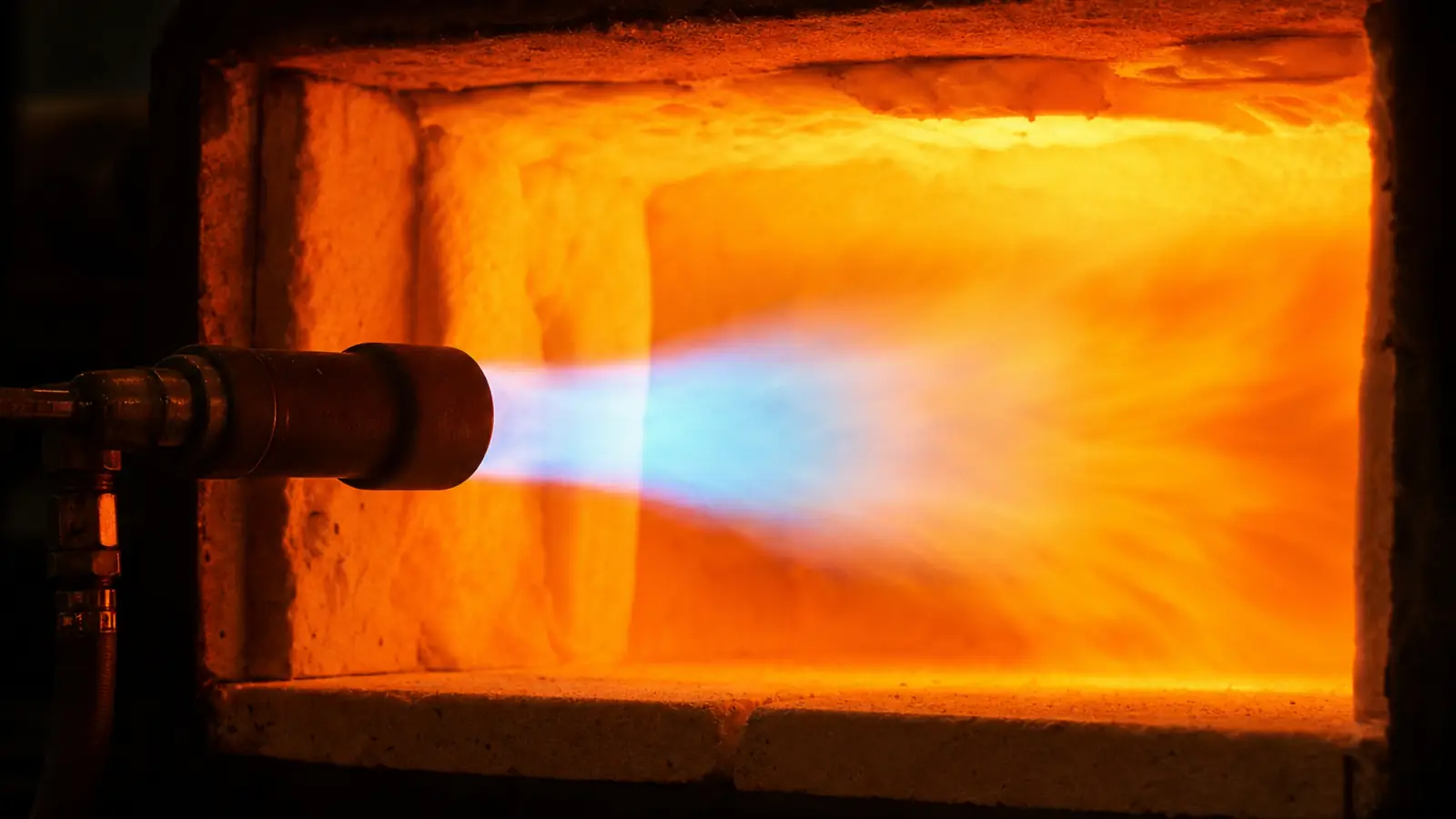
Inside a hot chamber the flame should look neutral: a short blue-ish inner cone with a soft, quiet secondary flame, no harsh roar and no lazy orange licking. Too much air (a lean, scale-forming flame) burns your steel; too little (a rich flame with heavy dragon's breath and soot) wastes gas and can produce carbon monoxide.
Adjust the air openings and pressure together until the chamber glows even and bright. If you plan to weld, you will push pressure higher and add flux; see forge welding for beginners.
Common Beginner Mistakes
A few errors show up again and again:
- Buying an oversized burner 'for headroom.' It just wastes propane and overheats a small chamber.
- Skipping the adjustable regulator. A fixed grill regulator caps you below forging heat.
- Ignoring the liner. A leaky or poorly insulated chamber makes even the right burner look weak; a well-rigidized ceramic-fiber liner does half the work.
- Aiming the burner straight down the center. That often creates a single hot spot, so most builders angle it slightly to make the flame swirl.
If you are still choosing insulation, run the numbers in the forge insulation calculator before you buy the burner.
Frequently asked questions
What size propane forge burner do I need?
It depends on your chamber volume. A single 3/4 in naturally-aspirated burner (~90,000 BTU/hr) heats up to about 350 cubic inches, which covers most beginner forges. Step up to a 1 in burner (~150,000 BTU/hr, ~700 cubic inches) for larger chambers. Measure interior length, width, and height after the liner, then plug the numbers into the burner BTU calculator.
Do I need a special regulator for a forge burner?
Yes. A standard fixed grill regulator only supplies about 1/2 PSI and cannot reach forging heat. Use an adjustable regulator: 0-20 PSI covers general forging, and 0-30 PSI gives the extra pressure for forge welding. It should end in a QCC-1 connection for modern US tanks, and the hose should match your burner's inlet thread.
Naturally-aspirated or blown burner for a beginner?
For a first forge, naturally-aspirated. It has no fan, needs no electricity, and comes tuned from most makers. Blown (fan-fed) burners offer finer air control and scale to large forges, but add wiring, a blower, and more setup. Most beginners never outgrow a good Venturi burner, so start there and move to blown only if you build something large.
Can one burner reach forge-welding heat?
One properly sized burner can reach forge-welding heat, but you need headroom. Forge welding wants roughly 25% more BTU than plain forging, so size the burner for a chamber about 20-25% smaller than its normal rating, and use a 0-30 PSI regulator. A well-insulated chamber and clean flux matter as much as raw burner output.
How do I know my flame is tuned correctly?
Judge the flame inside a hot chamber, not in open air. Aim for a neutral flame: a short blue-ish inner cone with a soft, quiet secondary and no orange licking. A loud roar or a lean, scale-forming flame is too much air; heavy dragon's breath and soot mean it is too rich and can make carbon monoxide. Adjust air and pressure together.
Last verified 2026-06. Specs, sizes and market prices change - confirm details on the retailer page before buying.