How to Start Blacksmithing (Without Wasting Money)
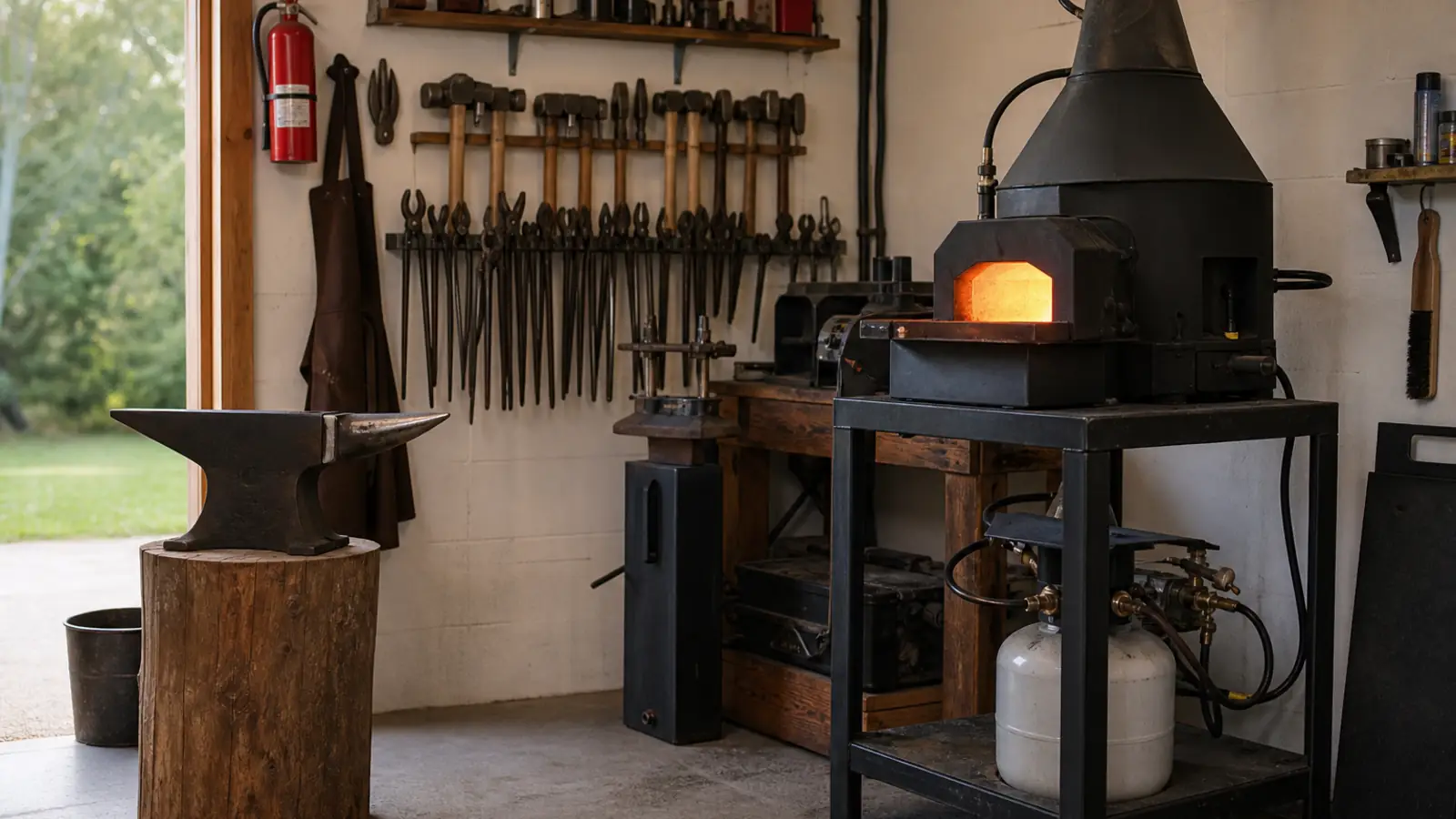
Quick answer
To start blacksmithing you need five core tools: a forge, an anvil, a hammer around 2 lb, one pair of tongs, and a sturdy vise, plus safety glasses and natural-fiber clothing. Most beginners spend $400-900 on a workable setup built around a single-burner propane forge and a 66 lb cast-steel anvil. Buy a few sticks of mild steel (ASTM A36), learn on hooks and openers rather than knives, and find a local guild through ABANA's affiliate directory - a hands-on intro class typically costs $100-400 and saves months of trial and error.
What you actually need to start blacksmithing
Forget the movie image of a barn-sized shop. Blacksmithing needs one thing physics-wise: steel hot enough to move, and something hard to hammer it against. Everything you buy serves that loop.
Five tools do the real work:
- Forge - the heat source. A single-burner propane forge is the beginner default: clean, predictable, and legal to run in a driveway.
- Anvil - a hardened steel face to work over. Around 66 lb (30 kg) is a workable floor for new smiths.
- Hammer - one cross-peen or rounding hammer around 2 lb (0.9 kg). Not the 4 lb monster; your forearm is the limiting factor, not the steel.
- Tongs - one well-fitting pair so you are not gripping orange-hot bar with pliers. Wolf-jaw tongs cover most beginner stock.
- Vise - a steel-jaw bench vise for bending, twisting, and holding work while you file.
Add three cheap extras on day one: ANSI-rated safety glasses, a wire brush for scale, and a metal bucket of water for cooling tongs and killing small fires. That is a complete starting shop. Smiths made hardware for centuries with less, and you can build every project in our beginner projects guide with exactly this kit.
| Item | What to look for | Typical US price (2026) |
|---|---|---|
| Single-burner propane forge | Import kits work; US-made units hold heat better | $70-120 import, $230-350 US-made |
| Anvil, 66 lb cast steel | Hardened face (50+ HRC), 70%+ ball-bearing rebound | $110-160 new import |
| Cross-peen hammer, ~2 lb | Hickory handle you can re-hang | $25-60 |
| Tongs, one wolf-jaw pair | Jaws that fit 3/8-1/2 in stock | $25-50 |
| Bench vise, steel jaws | Used is fine if the jaws close square | $30-100 |
| PPE: glasses, gloves, cotton or leather clothing | ANSI Z87.1 glasses; no synthetics | $40-100 |
| Mild steel assortment (A36) | 1/4, 3/8, and 1/2 in round and square bar | $30-60 |
| 20 lb propane tank plus first fill | Refill stations beat tank exchanges | $50-80 |
Estimate your propane cost per session
The five core tools, one at a time
Forge. Propane wins for most beginners: no chimney, no fuel prep, steady heat. A single burner around 80-100k BTU heats hooks and knife-sized stock fine; see our beginner propane forge picks for what matters (insulation thickness, an adjustable 0-30 psi regulator, a stable stand). Coal and charcoal work and cost less per hour, but they add smoke, neighbors, and a learning curve.
Anvil. You are paying for a hard face and rebound - drop a small ball bearing from 10 in and a decent steel anvil bounces it back 70% or more. A 66 lb cast-steel import is the common starting point at roughly $2 per pound. Avoid cast-iron anvil-shaped objects; they dent and soak up your hammer energy. A stood-on-end length of railroad track is a legitimate free alternative while you save - see rail vs. real anvil.
Hammer. Around 2 lb, with a face you keep smooth. Control beats mass for the first year.
Tongs. Buy one pair that fits the bar size you actually bought. Loose tongs launch hot steel; that is not a place to save $10.
Vise. A used 4-5 in bench vise handles bending and twisting until you find a proper post vise years from now.
Your first steel: mild A36
Start on hot-rolled A36 mild steel, the general-purpose structural grade sold by every steel supplier in the US. It has roughly 0.25% carbon or less, so it forges forgivingly across a wide window - work it from bright red through yellow, roughly 1700-2300F (930-1260C) - and it never asks you to make heat-treating decisions.
Buy 1/4 in and 3/8 in square or round for hooks and leaves, plus a stick of 1/2 in for heavier practice. At a local steel yard, small A36 bar typically runs $1-2 per foot in 20 ft sticks; big-box stores sell 3 ft pieces of the same sizes at three to five times that rate. Our guide on where to buy steel for blacksmithing covers suppliers, scrapyards, and what to avoid.
One habit to build immediately: read the color, not the clock. Keep the forging temperature chart nearby until glow colors are second nature - hammering steel that has dulled below red just work-hardens it and beats up your anvil.
Safety basics before you light anything
Blacksmithing is safer than its reputation, but only if you respect a few non-negotiables:
- Eyes. Wear ANSI Z87.1-rated safety glasses every minute you forge or grind. Flying scale and clipped-off steel are exactly the hazards OSHA's eye-protection rule (29 CFR 1910.133) exists for.
- Clothing. Cotton, wool, or leather only. Synthetics melt into skin. Closed leather boots, no gloves on your hammer hand (a glove there ruins grip and feedback; many smiths glove only the tong hand).
- Air. A propane forge makes carbon monoxide. Forge outdoors or with serious cross-ventilation, and mount a CO detector where you work.
- Fire. Keep a fire extinguisher and your quench bucket within reach; clear a 10 ft radius of anything flammable.
- Black heat. Steel below about 900F looks cold and will still burn you instantly. Treat every bar on the floor as hot until proven otherwise.
- Coatings. Never heat galvanized or plated steel - zinc fumes cause metal fume fever.
Read our full propane forge safety guide before your first burn; the leak-test habit alone is worth it.
Where to learn: classes, guilds, and ABANA
You can teach yourself from videos, but nothing compresses the learning curve like two days beside an experienced smith. Three routes, cheapest first:
- Local guilds and blacksmithing associations. ABANA (the Artist-Blacksmith's Association of North America) lists about 90 affiliate groups across the continent in its affiliate directory. Dues are commonly $20-50 a year, and most groups run open-forge nights where you can swing a hammer on someone else's equipment before spending a dollar on your own.
- Intro classes. Weekend beginner courses at craft schools, guild shops, and community colleges typically run $100-400 and get you safely through fire management, hammer control, and a first project or two.
- Structured self-teaching. If no group is nearby, work through a proven curriculum: tapers, points, scrolls, then hooks. A couple of the standard beginner blacksmithing books plus deliberate practice beats random video-hopping.
Whichever route you take, get hands-on early. One supervised session fixes hammer-grip mistakes that would otherwise take months to unlearn.
Realistic first projects (in order)
Pick projects that teach one skill each, forgive ugly results, and finish in a session:
- S-hook - tapering, bending, and matching two ends. The single best teacher in smithing.
- Drive hook or J-hook - adds a 90-degree bend and a flattened nail plate.
- Leaf keychain - drawing a point, spreading, veining, and curling.
- Bottle opener - punching or drifting a hole, plus clean finishing.
- Fire poker - a longer bar that teaches heat management and a decorative twist.
Resist the knife for your first months. Blades pile heat-treating, grinding, and geometry on top of hammer skills you do not have yet, and a failed knife teaches less than five finished hooks. When the S-hooks come out clean and symmetrical every time, you are ready to move up the difficulty ladder.
Common beginner mistakes
- Buying a cast-iron anvil because it was cheap. It dents, deadens every blow, and you will replace it. Put the savings toward steel, not regret.
- Too much hammer. A 4 lb hammer wrecks accuracy and elbows. Move up only after your 2 lb blows land where you look.
- Working the steel too cold. Below red heat you are stressing the bar and your joints. Reheat more often than feels efficient.
- Burning the steel. Mild steel sparkles and crumbles past roughly 2350F. If it throws sparks in the forge, that end is firewood.
- Buying tools speculatively. Skip hardy tools, swages, and five tong pairs until a project demands them.
- Forging mystery or coated scrap on day one. Stick to new A36 until you can identify steel and its hazards.
- Practicing alone forever. One open-forge night per month at a guild fixes more technique than ten hours of video.
How to start blacksmithing, step by step
- Sort out safety gear first Buy ANSI Z87.1 safety glasses, cotton or leather clothing, and closed leather boots before any tools. Add a CO detector and a fire extinguisher to the same order.
- Watch real smiths work Find a nearby guild through ABANA's affiliate directory and visit an open-forge night, or book a $100-400 intro class. One supervised session prevents months of bad habits.
- Set up your heat source Buy a single-burner propane forge ($70-120 import, $230-350 US-made) with an adjustable 0-30 psi regulator. Set it up outdoors on a steel or masonry surface and leak-test every fitting with soapy water.
- Put steel under your hammer Get a 66 lb cast-steel anvil, or a free railroad-track offcut stood on end. Mount it solidly at knuckle height - standing straight, your knuckles should just brush the face.
- Add hammer, tongs, and vise Choose a cross-peen hammer around 2 lb, one pair of wolf-jaw tongs that fit 3/8-1/2 in bar, and any solid steel-jaw bench vise, used is fine.
- Buy mild steel to practice on Pick up a few 20 ft sticks of hot-rolled A36 in 1/4, 3/8, and 1/2 in from a local steel supplier, about $1-2 per foot. Have them shear the sticks in half so they fit your vehicle.
- Forge hooks until they look bought Work through S-hooks, drive hooks, and leaves, reheating whenever the steel dulls below bright red. Aim for clean tapers and matching curves, not speed.
- Expand only when a project demands it Add tongs, hardy tools, and a bigger anvil as specific projects require them. Skill, not shopping, is what makes the next project possible.
Frequently asked questions
How much does it cost to start blacksmithing?
Most beginners spend $400-900 for a new entry-level setup: a $70-120 import propane forge, a $110-160 66 lb cast-steel anvil, hammer, tongs, vise, PPE, steel, and a propane tank. Determined scroungers using rail track and used tools get going for $200-400. Our cost breakdown itemizes three full budget tiers.
Can you teach yourself blacksmithing?
Yes - many working smiths are self-taught, and the core skills (tapering, bending, punching) respond well to deliberate solo practice. You will still progress noticeably faster with occasional feedback. A $100-400 weekend class or a guild open-forge night catches grip and posture mistakes early, when they take minutes rather than months to fix.
What steel should a beginner blacksmith use?
Hot-rolled A36 mild steel bar, roughly 0.25% carbon or less. It is cheap (about $1-2 per foot at a steel supplier), forges across a wide 1700-2300F window, and needs no heat treating. Buy 1/4 in and 3/8 in square or round for your first projects, and save spring steel and knife grades for later.
Do I need a real anvil to start?
No. A length of railroad track stood on end, a forklift tine, or any 50+ lb block of solid steel works while you learn. What matters is hard steel under the hammer, with mass directly below the strike. Plan to upgrade to a 66 lb or heavier steel anvil once you know the hobby sticks - the better rebound makes every session less tiring.
Can I blacksmith in my backyard or garage?
Usually yes as a hobby, but check local fire codes and HOA rules first. Run a propane forge outdoors or with strong cross-ventilation plus a CO detector - never in a closed garage. Keep 10 ft of clear space, an extinguisher, and a water bucket at hand. Noise is the neighbor issue people forget: an anvil rings, so forge at reasonable hours.
How long does it take to get decent at blacksmithing?
Expect competent basics - clean tapers, even bends, a respectable S-hook - after roughly 20-40 hours at the anvil. Simple sellable items like hooks and openers come within a few months of weekend practice. Skill tracks forge time, not calendar time, which is why one focused hour with a plan beats three hours of aimless hammering.
Last verified 2026-07. Specs, sizes and market prices change - confirm details on the retailer page before buying.