Railroad Track Anvil vs Real Anvil: What a Beginner Should Actually Use
Quick answer
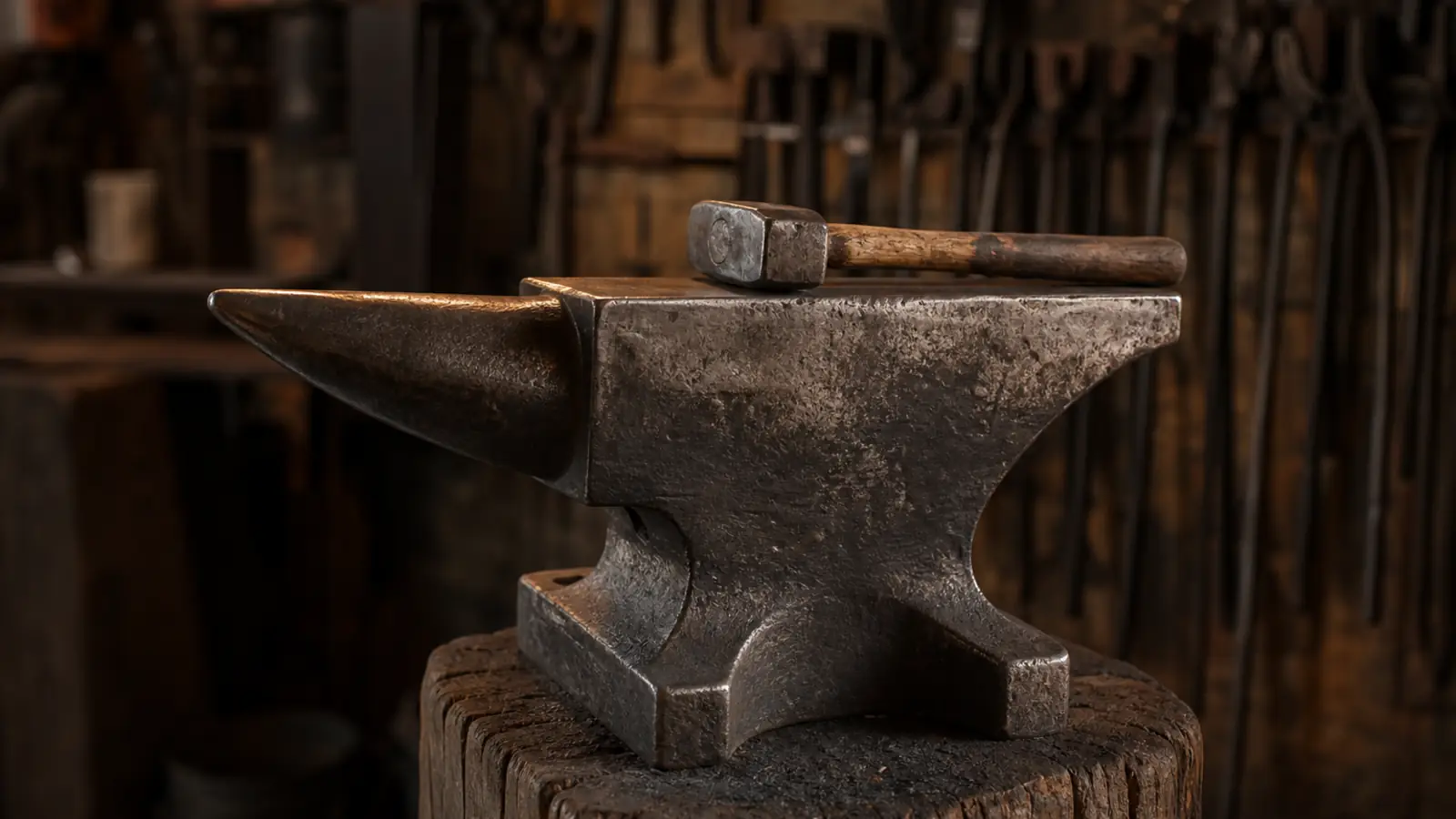
A railroad track anvil is a legitimate free or cheap start, and it works far better stood on-end so more mass sits under your hammer. But a real anvil gives you mass, a big flat face, a horn, a hardy hole, and better rebound. Start on rail if money is tight; buy a real anvil once you know you're committed.
The short version
Almost every beginner asks the same thing: is a railroad track a good anvil? The honest answer is that a piece of rail is a real, usable forging surface and a great way to start hammering hot steel this weekend for little or no money. It is not, however, the same tool as a real anvil, and the gap shows up fast once your projects get bigger.
Rail is decent, hard steel. Standard mainline rail in the US is a medium-carbon steel (often around 0.7-0.8% carbon in the head), which is why it rings, resists denting, and returns a fair amount of energy to your hammer. That is genuinely good news for a starter surface. What rail lacks is mass and geometry: a short chunk laid on its side is light, narrow, and has none of the features that make an anvil an anvil. Understanding those two problems tells you exactly how to get the most out of a rail, and when it stops being enough.
Why mass is the whole game
When your hammer hits hot steel, you want the anvil to stay put and bounce the blow back up into the work. Energy that moves the anvil, or gets absorbed by a springy stand, is energy that did not shape your metal. That is why anvil weight matters so much: a common rule of thumb is that your anvil should weigh roughly 40-50x your hammer, so a typical 2 lb hammer wants something in the 80-100 lb range, and around 66 lb is a sensible beginner floor for general work.
A foot-long piece of rail weighs only about 20-30 lb depending on the rail size. Laid on its side, that light, thin section flexes and moves, and a lot of your effort disappears. This is the single biggest reason a rail underperforms, and it is also the reason for the most important trick with rail: change how you orient it.
The trick: stand the rail on end
Lay a rail on its side and you are hammering over a thin, springy web. Stand that same rail vertically, on its end, and you are hammering straight down the full column of steel into the ground or a heavy stump. Now the mass under your hammer works for you instead of against you, rebound improves dramatically, and a short offcut suddenly feels like a much heavier tool.
The head of the rail (the wide top surface) becomes your working face. You can grind and dress it flat and smooth, radius the edges slightly so they do not cut into your work, and even shape a small horn or a step at one end with an angle grinder if you are patient. A vertical rail set into a log or bolted to a stout post is the single best cheap-anvil setup a beginner can build. If you go this route, our guide on how to mount an anvil applies to rail too: solid, low, and dead-quiet mounting makes any anvil hit harder.
| Factor | Railroad rail | Real anvil |
|---|---|---|
| Typical mass | ~20-40 lb offcut | 66-150+ lb |
| Working face | Narrow; must dress it | Wide, flat, ground |
| Rebound | Fair (good on end) | Good to excellent |
| Horn | None (grind your own) | Yes |
| Hardy hole | None | Yes (holds tools) |
| Cost | Free to ~$40 | $150-600+ new |
What a real anvil buys you
A real anvil is not just a heavier rail. It is a purpose-built tool, and each feature solves a job that rail cannot:
- A big flat face for drawing out and flattening without chasing a narrow strip of steel.
- A horn for bending curves, forming rings, and drawing tapers over a radius.
- A hardy hole (the square hole) that holds cutoff tools, bending forks, and swages, turning your anvil into a whole tool system.
- A pritchel hole (the round hole) for punching holes cleanly.
- Consistent, high rebound across a hardened face, so every blow is efficient.
On a decent steel anvil, a dropped ball bearing should bounce back about 70% or more of the drop height. That rebound test is the fastest way to judge any anvil (or a rail face) before you commit.
The upgrade: entry cast-steel anvils
When you outgrow the rail, an entry cast-steel anvil is the natural first real anvil: hard face, real horn and hardy hole, and a sane price per pound. Here are the two size classes most beginners choose from.
Cast-steel anvil 66 lb
19 x 4 x 10 in
- Weight
- 66 lb
- Material
- Cast Steel
- Hardness
- ~50 HRC
- Face (in)
- 3.9 x 9.8
- Hardy hole
- 1 in
Popular beginner weight. Ring and rebound vary by batch - test rebound with a ball bearing if you can.
Cast-steel anvil 55 lb
17 x 3.5 x 9 in
- Weight
- 55 lb
- Material
- Cast Steel
- Hardness
- ~48 HRC
- Face (in)
- 3.5 x 9
- Hardy hole
- 0.9 in
Light and portable but bounces on light stands. Bolt it down or mount to a heavy stump.
Cast-steel anvil 70 lb
20 x 4 x 10 in
- Weight
- 70 lb
- Material
- Cast Steel
- Hardness
- ~52 HRC
- Face (in)
- 4 x 10
- Hardy hole
- 1 in
A little more mass than the 66 lb for a similar price. Marketing hardness claims are often optimistic.
Cast-steel anvil 132 lb
26 x 4.5 x 12 in
- Weight
- 132 lb
- Material
- Cast Steel
- Hardness
- ~52 HRC
- Face (in)
- 4.5 x 12
- Hardy hole
- 1 in
Enough mass for confident general forging. Shipped by freight - check delivery cost, not just Prime.
Cast-steel anvil 110 lb
24 x 4.3 x 11 in
- Weight
- 110 lb
- Material
- Cast Steel
- Hardness
- ~50 HRC
- Face (in)
- 4.3 x 11
- Hardy hole
- 1 in
Middle-weight all-rounder. Verify hardy hole size matches tools you plan to buy.
Cast-steel anvil 150 lb
27 x 5 x 13 in
- Weight
- 150 lb
- Material
- Cast Steel
- Hardness
- ~54 HRC
- Face (in)
- 5 x 13
- Hardy hole
- 1 in
Great shop anvil weight. Freight only - budget for a pallet or curbside delivery.
How to choose your upgrade size
The 55-70 lb class is the beginner floor. It is easy to move, easy to mount, and enough anvil to learn hammer control, make hooks, bottle openers, small knives, and light hardware. If your bench space or budget is tight, this is a perfectly honest starting anvil.
The 110-150 lb class is where most people wish they had started. The extra mass means less bounce-around, more efficient blows on thicker stock, and a face big enough that you are not constantly repositioning. If you already know you want to forge bigger stock or make bladesmithing a real hobby, buy heavier once and skip the intermediate step.
Whatever size you pick, judge the deal by dollars per pound, not sticker price. In today's US market, budget cast steel runs roughly $2-4/lb, mid-tier new around $4-7/lb, and premium forged anvils $7-12/lb. A used bargain under $2/lb is a great find. Run any candidate through the anvil price-per-pound calculator before you drive across the state to buy it.
The verdict
A railroad track anvil is a legitimate free start, and standing it vertically is what makes it genuinely usable rather than just barely workable. If you have access to a rail offcut, dress the face, mount it on end in a heavy stump, and start forging. You will learn hammer control and heat control on it perfectly well.
But a real anvil is worth it once you are committed. The mass, the flat face, the horn, and the hardy hole are not luxuries. They are the difference between fighting the tool and forgetting about it. Think of the rail as your free trial. The day you catch yourself wishing for a horn or a hardy hole, you are ready to upgrade, and an entry cast-steel anvil is the honest next step.
Frequently asked questions
Is a railroad track a good anvil for a beginner?
Yes, as a starter. Rail is hard, medium-carbon steel that rings and rebounds reasonably, so a rail anvil lets you forge for free or nearly free. Its weakness is low mass and no horn or hardy hole. Stand the rail on end to put more steel under your hammer, dress the face flat, and it will carry you through your first months of learning cleanly.
Why should you stand a railroad anvil on end?
Laid on its side, a rail hammers over a thin, springy web that flexes and wastes your blows. Stood vertically, you drive straight down the full column of steel into a heavy stump, so mass works for you and rebound improves dramatically. This single change makes a light train track anvil hit far more like a real anvil for very little effort or cost.
How heavy should my first real anvil be?
Match it to your hammer: an anvil should weigh roughly 40-50 times your hammer, so a 2 lb hammer wants 80-100 lb. About 66 lb is a workable beginner floor for general work, while the 110-150 lb class gives less bounce and more efficient blows. If you already plan to forge bigger stock, buy heavier once rather than upgrading twice.
How do I tell a real steel anvil from a cast-iron ASO?
Use the rebound test: drop a ball bearing on the face and watch how high it returns. Good steel gives back about 70% or more; a soft cast-iron anvil-shaped object barely bounces. Also listen for a clear ring and ask the seller whether it is steel or iron. Never pay more than about $1.50 per pound for anything you suspect is cast iron.
Is rail steel hard enough to forge on?
Yes. Mainline US rail is a medium-carbon steel, roughly 0.7-0.8% carbon in the head, which is why it resists denting and returns energy to your hammer. That makes a rail anvil surprisingly capable once you dress the face flat. It will not match a hardened anvil face for consistency, but it is far harder and better than any cast-iron ASO.
When is it worth upgrading from a rail to a real anvil?
Upgrade once you are committed and start wishing for features rail cannot offer: a wide flat face, a horn for curves, and a hardy hole for tooling. If you are forging most weekends or moving to bigger stock and bladesmithing, an entry cast-steel anvil in the 66-132 lb range pays for itself in efficiency and comfort quickly.
Last verified 2026-06. Specs, sizes and market prices change - confirm details on the retailer page before buying.