Blacksmithing Tools for Beginners: What You Actually Need to Start
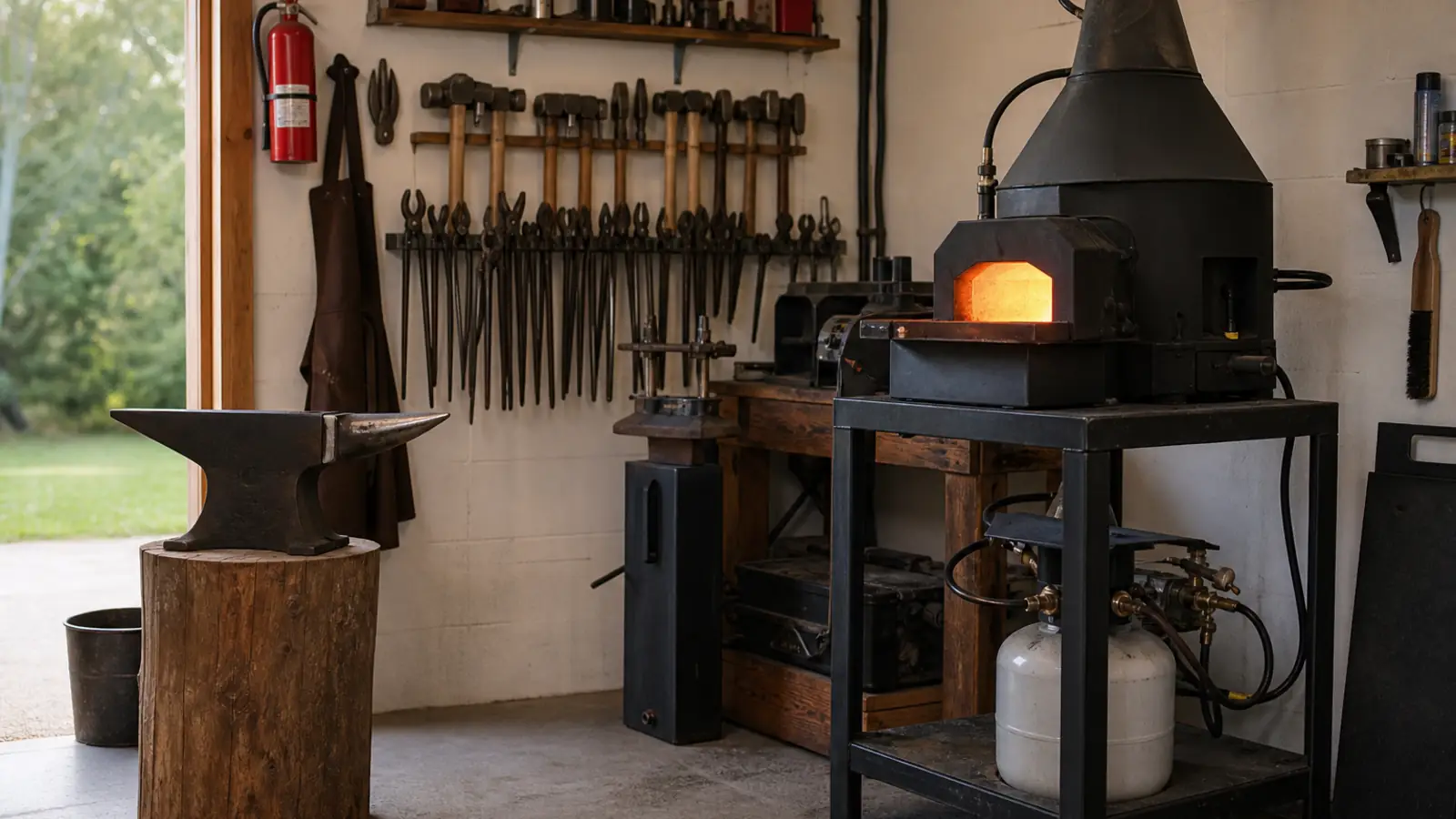
Quick answer
To start blacksmithing you need six things: a heat source (propane forge or a simple coal setup), an anvil or a chunk of rail, a hammer around 2 lb, a pair of tongs, a steel-jaw vise, and PPE. Add a wire brush and a quench bucket. Everything else can wait until you have made a few hooks.
What tools do blacksmiths use to start?
People imagine blacksmithing needs a whole shop full of gear. It does not. The craft is old and stubbornly simple: you heat steel until it moves, and you hit it with a hammer over a hard face. Everything past that is refinement.
Here is the honest core kit for a beginner. Six essentials do real work:
- A heat source - a single-burner propane forge for most people, or a homemade coal/charcoal setup if you like tinkering
- An anvil - a real steel anvil around 66 lb, or a heavy chunk of railroad track stood on end while you save up
- A hammer - a cross-peen around 2 lb is the classic all-rounder
- Tongs - one versatile pair so you are not holding hot steel with pliers
- A vise - a sturdy steel-jaw bench vise for holding, bending, and twisting
- PPE - safety glasses, cotton or leather clothing, closed leather boots, no synthetics
Two cheap extras belong in that first list because they matter on day one: a wire brush to knock scale off before you look at your work, and a quench bucket (just a metal pail of water) to cool tongs and stop small fires. That is the whole starting shop. You can build hooks, openers, and hardware with it for a year.
| Tool | Start now? | Why / when |
|---|---|---|
| Propane forge | Yes | Cleanest, most predictable heat for a beginner |
| Anvil (~66 lb) | Yes | Rail works short-term; a real face pays off fast |
| Cross-peen hammer ~2 lb | Yes | Your main tool; light enough to control all session |
| One pair of tongs | Yes | Safe grip on hot stock; match to your bar size |
| Steel-jaw bench vise | Yes | Bending, twisting, holding for filing |
| Wire brush + quench bucket | Yes | Scale removal and safety; a few dollars |
| Hardy tools (hot cut, fork) | Later | Add once you know which cuts you repeat |
| Post/leg vise | Later | Upgrade from bench vise for heavy bending |
| More tongs | Later | Buy to fit stock you actually use |
Budget your forge running cost
Beginner tools worth featuring
These are the generic types most beginners end up buying. A bundled starter kit can save money if it hits the essentials, but many kits skimp on the anvil, so read the individual picks too.
Blacksmith starter tool kit (hammer, tongs, brush)
varies
Tools-only kit to pair with a forge and anvil you buy separately. Confirm hammer weight and tong jaw size fit your plans.
Blacksmith starter kit with propane forge
varies
- BTU/hr
- 90,000
- Burners
- 1
- Regulator
- 0-20 PSI
All-in-one bundle including a small single-burner forge. Convenient, but the anvil is usually undersized - plan to upgrade it.
Knife-maker starter kit
varies
Aimed at first knives - often steel, files and a guide. Check whether a forge and quench setup are included or extra.
Cross-peen hammer 2 lb
13 in handle
- Weight
- 2 lb
- Material
- Forged Steel
- Face (in)
- 1.25
- Handle
- Hickory
Standard beginner weight. Re-hang and dress the face if it arrives with a rough or sharp-edged finish.
Swedish-pattern cross-peen 2.2 lb
14 in handle
- Weight
- 2.2 lb
- Material
- Forged Steel
- Face (in)
- 1.3
- Handle
- Hickory
Slightly heavier head with a crisp peen for drawing out. Comfortable all-day weight for most adults.
Cross-peen hammer 1.5 lb
12 in handle
- Weight
- 1.5 lb
- Material
- Forged Steel
- Face (in)
- 1.1
- Handle
- Hickory
Lighter option if 2 lb tires your wrist or elbow. Better for detail and small knives.
Wolf-jaw tongs 3/8 in
18 in
- Material
- Forged Steel
- Jaw capacity
- 0.375 in
The most versatile first tong - grips flat, round and square stock near 3/8 in. May need adjusting on the anvil to seat well.
Wolf-jaw tongs 1/2 in
19 in
- Material
- Forged Steel
- Jaw capacity
- 0.5 in
Same versatile jaw sized for 1/2 in stock. Good second tong once you outgrow 3/8 in.
Cast-steel anvil 66 lb
19 x 4 x 10 in
- Weight
- 66 lb
- Material
- Cast Steel
- Hardness
- ~50 HRC
- Face (in)
- 3.9 x 9.8
- Hardy hole
- 1 in
Popular beginner weight. Ring and rebound vary by batch - test rebound with a ball bearing if you can.
Cast-steel anvil 55 lb
17 x 3.5 x 9 in
- Weight
- 55 lb
- Material
- Cast Steel
- Hardness
- ~48 HRC
- Face (in)
- 3.5 x 9
- Hardy hole
- 0.9 in
Light and portable but bounces on light stands. Bolt it down or mount to a heavy stump.
Cast-steel anvil 70 lb
20 x 4 x 10 in
- Weight
- 70 lb
- Material
- Cast Steel
- Hardness
- ~52 HRC
- Face (in)
- 4 x 10
- Hardy hole
- 1 in
A little more mass than the 66 lb for a similar price. Marketing hardness claims are often optimistic.
Compact single-burner propane forge
14 x 8 x 8 in shell
- BTU/hr
- 90,000
- Burners
- 1
- Chamber (in)
- 9 x 4.5 x 3
- Weight
- 22 lb
- Regulator
- 0-20 PSI
- Firebrick
- Included
Good first forge for knives and small stock. Confirm the interior length fits your longest workpiece before buying.
Long single-burner knife forge
18 x 8 x 8 in shell
- BTU/hr
- 100,000
- Burners
- 1
- Chamber (in)
- 12 x 4.5 x 3
- Weight
- 27 lb
- Regulator
- 0-30 PSI
- Firebrick
- Included
Longer chamber suits blade work. Ships with a 0-30 PSI regulator on most listings - verify the range.
Economy single-burner forge
12 x 7 x 7 in shell
- BTU/hr
- 80,000
- Burners
- 1
- Chamber (in)
- 8 x 4 x 3
- Weight
- 18 lb
- Regulator
- 0-20 PSI
- Firebrick
- Included
Lowest-cost entry option. Interior is short - fine for hooks and small knives, tight for anything long.
Single-burner farrier-style forge (open ends)
15 x 8 x 8 in shell
- BTU/hr
- 95,000
- Burners
- 1
- Chamber (in)
- 10 x 5 x 3
- Weight
- 24 lb
- Regulator
- 0-20 PSI
- Firebrick
- Included
Open front and back let you pass long bar through. Open ends waste some heat - plan for a firebrick baffle.
Single-burner forge with front door
16 x 9 x 9 in shell
- BTU/hr
- 110,000
- Burners
- 1
- Chamber (in)
- 9 x 5 x 3.5
- Weight
- 26 lb
- Regulator
- 0-30 PSI
- Firebrick
- Included
Front door helps hold welding heat. Confirm whether a 0-30 PSI regulator is included for forge-welding pressure.
How to choose each piece without overspending
Forge. A single-burner propane forge (around 80-110k BTU) heats a knife blade or small bar to bright orange easily and sips gas compared with a double-burner. Beginners rarely need welding heat or a long chamber in year one, so start single and read our single vs. double burner comparison before you upgrade. Coal is cheaper to buy but messier and needs a chimney; see propane vs. coal if you are undecided.
Anvil. The old rule is that your anvil should weigh roughly 40-50x your hammer, so a 2 lb hammer wants at least an 80-100 lb face for efficient work, but a 66 lb cast-steel anvil is a common and workable beginner floor. What you are really paying for is a hard face and rebound: drop a ball bearing and a good steel anvil returns 70% or more of the drop. Avoid cast iron ASOs (anvil-shaped objects) at any price over about $1.50/lb - they are too soft and eat your energy. A stood-up length of railroad track is a legitimate free starting anvil; see rail vs. real anvil.
Hammer. Around 2 lb is the sweet spot. Heavier hammers move more metal but wear out a new smith's forearm and technique before the steel cools. A hickory handle you can re-hang beats a fiberglass one you cannot.
Tongs. Buy one versatile pair first - wolf-jaw tongs grip flat, round, and square stock, which covers most beginner projects. Match the jaw to the stock you plan to use (often 3/8 in or 1/2 in). Bad-fitting tongs launch hot bars, so this is not the place to save five dollars.
First forging projects, in order of difficulty
Do not start with a knife. Start with projects that teach one skill each and forgive mistakes. Work through these roughly in order:
- J-hook or S-hook - pure tapering and bending; the fastest way to learn hammer control and how hot steel behaves
- Bottle opener - a forged hook or drifted hole plus clean finishing; a great gift that hides small flaws
- Leaf keychain - teaches the leaf technique (draw a point, spread, vein, curl the stem); pretty and quick
- Drive hook / wall hook - a point on one end, a bend and a flattened nail plate on the other; introduces punching
- Letter opener - your first blade-shaped piece: taper, spread, and file a bevel without heat-treating anything critical
Use mild steel (A36) or plain scrap you can identify. A36 forges wide and forgiving, up to around 2300F. Once you can make a clean, symmetrical S-hook every time, you have the fundamentals for almost everything else. Keep the forging temperature chart in view so your colors stay in range - most beginner work happens in the bright-orange-to-yellow window, roughly 1500-2100F for carbon steels.
How to forge a simple S-hook
- Cut your stock Cut about 6-7 in of 1/4 in or 3/8 in mild steel (A36) round or square bar. This length gives you enough to taper both ends and still hold safely with tongs.
- Heat to working color Bring the first few inches up to a bright orange, roughly 1500-1900F. Work only while the steel is that color; when it dulls to red, stop and reheat rather than beating cold metal.
- Taper the first end Hold the bar at a slight angle over the far edge of the anvil face and hammer, rotating the bar 90 degrees between blows to keep it even, then round the point if you want. Draw it out to a clean, tidy taper.
- Taper the second end Reheat, flip the bar, and repeat the taper on the opposite end. Aim to match the first taper in length and shape so the finished hook looks symmetrical.
- Curl the first end Reheat one tapered end. Lay the tip over the anvil horn or edge and roll it into a curl, walking the bar forward as you tap so the curve stays smooth and round.
- Curl the second end the opposite way Reheat the other end and curl it in the opposite direction, so the two hooks face away from each other and form the S shape. Match the size of the first curl by eye.
- Adjust and finish Take a final heat, set the S flat on the anvil, and true up any twist or uneven curve with light taps. Wire-brush off the scale, then let it air cool or quench in your water bucket.
Frequently asked questions
What tools do blacksmiths use as a bare minimum?
A heat source (propane forge or coal fire), an anvil or heavy steel to work over, a hammer around 2 lb, tongs to hold hot stock, and a sturdy vise. Add a wire brush and a quench bucket of water. Those are the tools you need to start blacksmithing - everything else, from hardy tools to a post vise, is an upgrade you buy once you know your own work.
What are the best first forging projects for a beginner?
Start with a J-hook or S-hook to learn tapering and bending, then a bottle opener, a leaf keychain, a drive hook, and finally a letter opener. Each teaches one core skill and forgives mistakes. Save knives for after you can forge a clean, symmetrical S-hook every time, since blades add heat-treating and geometry on top of the basics.
Do I need a real anvil to start, or will railroad track work?
A stood-up length of railroad track works as a free starting anvil - set it on end so the mass is under your hammer, not lying flat. It gets you forging today. A real steel anvil around 66 lb has a bigger hard face and better rebound, which makes work faster and less tiring, so plan to upgrade once you are sure you enjoy the craft.
How much do beginner blacksmith tools cost to get started?
You can realistically start for a few hundred dollars: a single-burner propane forge, an entry cast-steel anvil around 66 lb, a 2 lb cross-peen hammer, one pair of tongs, and PPE. A bench vise, wire brush, and quench bucket add little. Buying a used anvil under $2/lb or a well-chosen starter kit stretches the budget further without cutting the essentials.
What hammer weight should a beginner blacksmith use?
Around 2 lb (0.9 kg) is the standard beginner blacksmith hammer. It moves enough metal for hooks, openers, and small tools while staying light enough to control for a whole session. Heavier hammers tire your forearm and wreck your technique before the steel cools. Pick a hickory handle you can re-hang and grow into a heavier hammer only when your control is solid.
Can I forge any scrap metal I find?
No. Never forge galvanized, zinc-plated, or unknown coated steel - heating zinc releases fumes that cause metal fume fever. Stick to identifiable mild steel like A36, or known stock such as coil or leaf spring once you advance. Mystery scrap can also be cast iron or alloys that crack or spark unpredictably, so when in doubt, buy a length of new mild steel bar - it is cheap and safe.
Last verified 2026-06. Specs, sizes and market prices change - confirm details on the retailer page before buying.