The Best Blacksmith Tongs for Beginners (and What to Buy First)
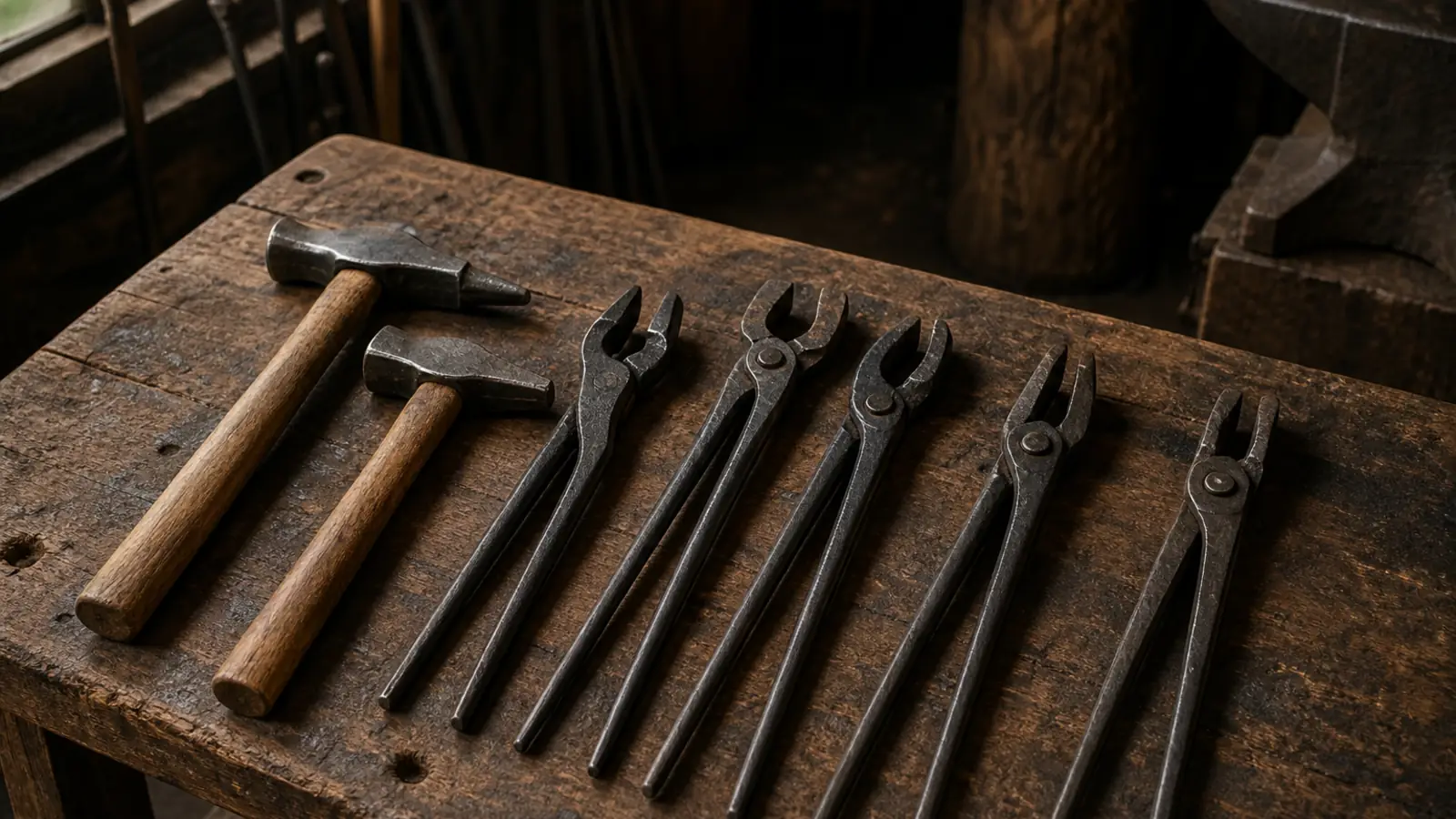
Quick answer
Buy one pair of wolf-jaw tongs first. They grip flat, round, and square bar in the small sizes a beginner actually forges, so a single pair covers most early projects. Add v-bit tongs when you work a lot of round or square stock, and treat cheap tong sets as raw material you will need to fit hot.
What tongs actually do (and why beginners overbuy)
Tongs are how you hold hot steel that is too short, too hot, or too awkward to hold in your bare hand. That is the whole job. The trap beginners fall into is buying a huge assortment before they know what stock they forge, then ending up with eight pairs that all grip the wrong size.
Here is the honest version: a well-fitted pair of tongs holds your workpiece so it does not rotate, slip, or fly out when you strike it. A poorly fitted pair fights you on every heat and slings glowing steel across the shop. The difference is almost never the brand. It is whether the jaws match your stock and whether the tongs have been fit to that stock. So your first buying decision is not "which set," it is "which one pair grips the most of what I forge."
For most beginners forging 1/4 in to 1/2 in (6-13 mm) flat, round, and square bar, that one pair is a set of wolf-jaw tongs.
Blacksmith tongs types, explained
There are dozens of specialized patterns, but a beginner only needs to understand a handful. Every tong type is named for its jaw, and the jaw is what determines what it can hold securely.
- Wolf-jaw (universal): the jaw has grooves plus a flat, so one pair can grip flat, round, and square bar within a size range. The best single first purchase because it does several jobs adequately rather than one job perfectly.
- V-bit / bolt tongs: a machined V that self-centers round and square bar and holds it dead straight along the reins. Excellent for round stock, drawing out square bar, and anything you want to keep from twisting.
- Flat-jaw / flat-bit: simple flat jaws for holding flat stock, plate, and knife blanks against the anvil face.
- Box / bolt-jaw: wraps around square or round stock on multiple faces for a very secure hold on heavier work.
- Scroll / duckbill and rivet tongs: specialty jaws you can ignore until a project demands them.
Notice the pattern: the jaw shape and the jaw size together define the tool. A wolf-jaw sized for 1/4 in bar will not hold 1/2 in bar well, and vice versa.
| Tong type | Best at | Weak at | Buy order |
|---|---|---|---|
| Wolf-jaw | Flat, round, square in one pair | Nothing perfectly; a jack of all | First |
| V-bit / bolt | Round + square, self-centering | Wide flat stock | Second |
| Flat-jaw | Flat bar, plate, knife blanks | Round stock (rolls out) | As needed |
| Box / bolt-jaw | Heavy square/round, secure wrap | Small thin stock | Later |
| Tong set (mixed) | Covering many sizes cheaply | Consistency; often needs fitting | Optional |
Tongs we would feature for a first buy
These generic types cover the realistic beginner path: one versatile pair, one specialist for round and square bar, and the budget-set route if you want spare pairs to fit yourself. Specs and current pricing are pulled in automatically below.
Wolf-jaw tongs 3/8 in
18 in
- Material
- Forged Steel
- Jaw capacity
- 0.375 in
The most versatile first tong - grips flat, round and square stock near 3/8 in. May need adjusting on the anvil to seat well.
Wolf-jaw tongs 1/2 in
19 in
- Material
- Forged Steel
- Jaw capacity
- 0.5 in
Same versatile jaw sized for 1/2 in stock. Good second tong once you outgrow 3/8 in.
V-bit bolt tongs 1/2 in
18 in
- Material
- Forged Steel
- Jaw capacity
- 0.5 in
V-shaped jaws self-center round and square bar. Great for tapers and bolt/rivet work.
V-bit tongs 3/4 in
20 in
- Material
- Forged Steel
- Jaw capacity
- 0.75 in
Larger V-bit for heavier round and square stock. Check that jaws close evenly on your bar size.
Blacksmith tong set (3 piece)
18 in each
- Material
- Forged Steel
- Jaw capacity
- 0.25-0.5 in
Usually a flat-jaw, a v-bit and a wolf-jaw. Fit and finish vary - budget time to adjust the jaws.
Blacksmith tong set (5 piece)
18-20 in
- Material
- Forged Steel
- Jaw capacity
- 0.25-0.75 in
Broader range of jaw shapes for growing projects. Individual quality is lower than buying good tongs one at a time.
Match the jaw size to your stock (this matters more than anything)
Tongs are sold by the stock size they are cut for, usually stamped or listed as something like 1/4 in, 3/8 in, or 1/2 in, and often as a range. A pair that closes fully on 1/4 in bar has too much gap to hold 1/2 in bar securely, and a pair cut for 1/2 in will only pinch the corners of 1/4 in stock.
Before you buy, write down what you actually forge. If most of your early work is small flat and round bar in the 1/4-3/8 in range, buy tongs cut for that range. It is far better to have one pair that fits your bar than three pairs that all fit something else.
A quick check when the tongs arrive: hold a cold piece of your target stock in the jaws and squeeze the reins together. The jaws should contact the stock along their full length, not just at the tip or the hinge. If they only touch at one point, the tongs need fitting - which is normal, and easy.
Fitting and adjusting tongs hot on the anvil
Almost every pair of tongs, cheap or expensive, benefits from being fit to your exact stock, and this is a skill worth learning on day one. Fitting means reshaping the jaws so they clamp your bar evenly.
The method: heat the jaw area (not the reins) to a bright orange, place a piece of your target stock between the jaws, and close the tongs on it against the anvil face or in the vise. Tap the jaws with a hammer so they conform to the bar. Let everything cool and test the grip cold. Repeat until the jaws hold the stock with no wobble.
You can also open or close the reins the same way: heat the reins near the pivot and gently spread or squeeze them so they rest comfortably in your hand when the jaws are closed on stock. Reins that are sprung too wide tire your hand fast; reins clamped shut give you no grip range. A cheap set that grips poorly out of the box is often 10 minutes of fitting away from being genuinely useful, which is the real argument for and against tong sets.
Reins, length, and a grip that does not exhaust you
Rein length affects both leverage and comfort. Longer reins (around 16-18 in / 40-45 cm on beginner tongs) give more clamping force for less hand effort and keep your hand farther from the heat, which is why most general-purpose tongs use them. Very short reins put your knuckles near the forge and force you to squeeze harder.
For a secure hold on longer sessions, many smiths slip a tong ring (also called a tong clip) over the reins to lock the jaws shut so you are not death-gripping the steel. You do not need one to start, but it is a cheap upgrade that saves your forearm. Whatever you buy, make sure the reins are steel you can reshape - mild steel reins bend to fit your hand easily, which is exactly what you want.
Frequently asked questions
What is the best blacksmith tongs for beginners to buy first?
A single pair of wolf-jaw tongs sized to your stock. Wolf-jaw tongs grip flat, round, and square bar within a size range, so one pair covers most early projects instead of forcing you to buy a separate tong for each shape. Once you know what you forge most, add a v-bit pair for round and square stock.
What are the main blacksmith tongs types?
The beginner-relevant blacksmith tongs types are wolf-jaw (universal flat, round, and square), v-bit or bolt tongs (self-centering round and square bar), flat-jaw (flat stock and knife blanks), and box or bolt-jaw (secure wrap for heavier square and round). Specialty patterns like scroll, duckbill, and rivet tongs come later, only when a specific project needs them.
Do I really need to fit blacksmithing tongs before using them?
Usually yes, and it takes only a few minutes. Fitting means heating the jaws to a bright orange, clamping them on your target stock against the anvil, and tapping until the jaws contact the bar along their full length. This is especially important for cheap tong sets, where jaws often arrive misaligned. Well-fit tongs hold work without wobble or slinging hot steel.
Are cheap blacksmith tong sets worth it?
They can be, if you treat them as blanks to tune rather than finished tools. Tong sets give you several jaw types cheaply, but quality varies pair to pair and jaws are frequently misaligned, so plan to fit each pair hot. If you do not yet want to learn fitting, one quality wolf-jaw pair is a better, less frustrating starting point.
How do I choose the right jaw size for my tongs?
Match the tongs to the stock you forge most. Tongs are cut for a specific bar size or range, and a pair sized for 1/4 in bar will not hold 1/2 in securely. Test by clamping a cold piece of your stock in the jaws: they should touch along the full jaw length, not just at the tip or hinge. If they touch at one point, fit them hot.
What length reins should beginner tongs have?
Around 16-18 in (40-45 cm) is a comfortable general-purpose length. Longer reins give more clamping leverage for less hand effort and keep your hand farther from the forge heat. Mild-steel reins are ideal because you can heat and reshape them to fit your grip. A tong ring slipped over the reins locks the jaws shut so you are not constantly squeezing.
Last verified 2026-06. Specs, sizes and market prices change - confirm details on the retailer page before buying.