How to Set Up a Blacksmith Shop
Quick answer
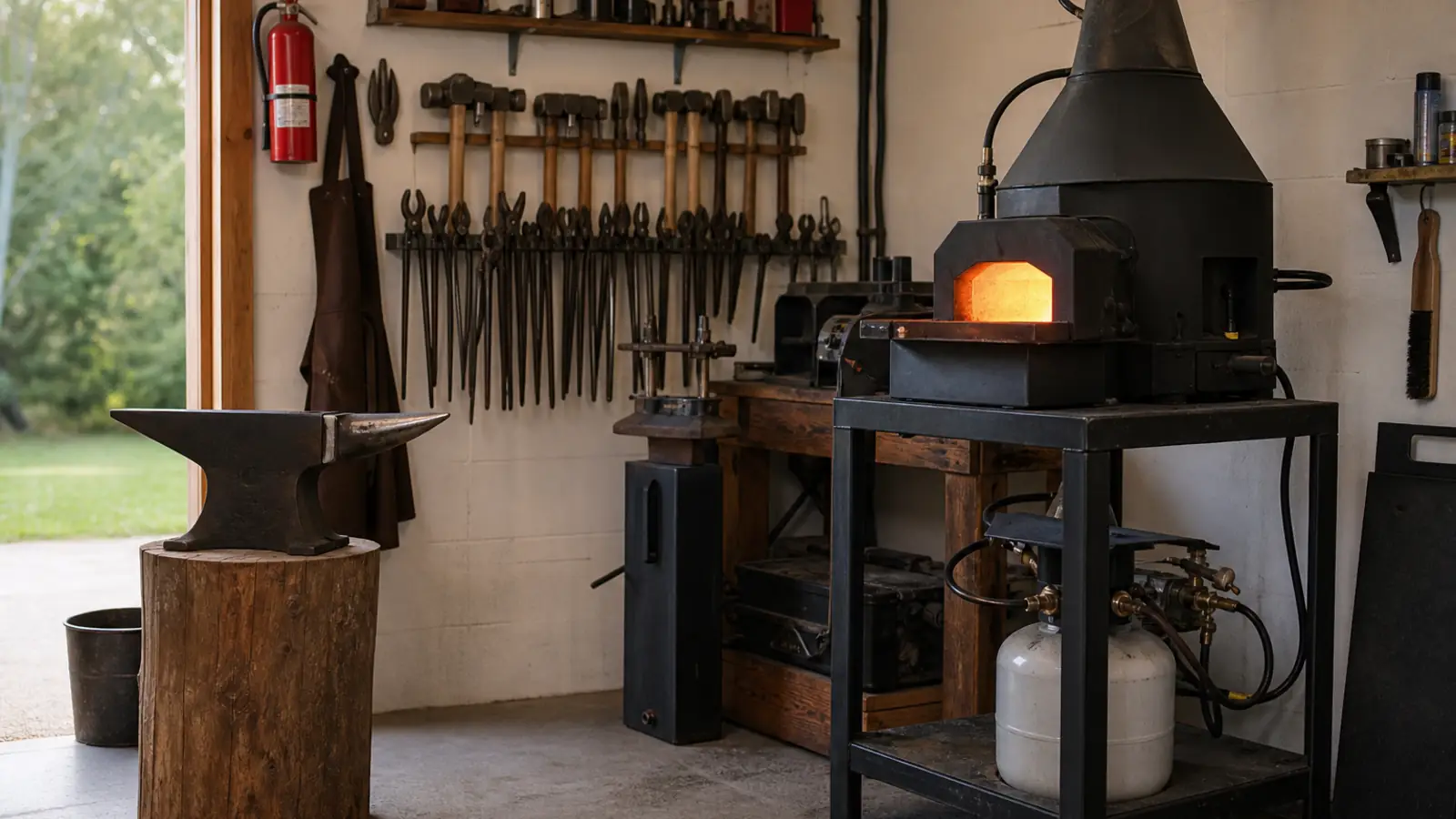
To set up a home blacksmith shop, pick a ventilated, non-combustible space - an open garage, shed, or outdoor lean-to with a CO detector nearby. Then buy the four essentials: a single-burner propane forge, a 66 lb or heavier anvil mounted at knuckle height, a post vise on a sturdy bench, and one hammer plus one pair of tongs. Add a grinder and specialty tools as projects demand.
What a Home Blacksmith Shop Really Needs
You do not need a dedicated smithy to start forging. A functional beginner shop fits in a single-car garage bay, a backyard shed, or an open lean-to, and the core kit is smaller than most people expect: a heat source, an anvil, a way to hold work, and a hammer. Everything else is an upgrade you buy once you know what you are making.
The trap for new smiths is buying gadgets before the four things that matter. Spend your money on a solid anvil and a real forge first, get them mounted and safe, then add tongs, files, and specialty tools as projects demand. This page is the master blacksmith tools list and links out to a dedicated buying guide for every station, so use it as your map and dive deeper where you are ready to spend.
Space and Safety Come First
Before you buy a single tool, pick a spot you can make safe. Forging throws sparks and scale, and a propane or coal forge produces carbon monoxide, so the space has to breathe.
- Location: an open garage with the door up, a shed with cross-ventilation, or an outdoor lean-to. Never run a forge in a closed room or under living quarters.
- Floor: bare concrete, packed dirt, gravel, or paver stones. Keep the area under and around the forge clear of wood, sawdust, and anything that melts or burns.
- Clearance: leave several feet of open space around the forge mouth, and store the propane cylinder outside and upright, away from the flame.
- Air: mount a battery CO detector on the wall and keep a charged fire extinguisher within arm's reach. If you smell exhaust or feel a headache starting, stop and open up the space.
Coal forges add smoke and more CO than gas, so they need even stronger ventilation or an outdoor setup with a chimney. If you are still deciding on a heat source, compare the tradeoffs in propane forge vs. coal forge.
| Tier | Rough budget | What you get | First priority |
|---|---|---|---|
| Starter | $300-600 | Single-burner forge or starter kit, 66 lb cast-steel anvil, one hammer, one tong pair, safety gear | Anvil + forge |
| Solid | $700-1,200 | Named beginner forge, 100+ lb anvil, post vise, 2-3 tongs, angle grinder, quench oil | Vise + grinder |
| Serious | $1,500+ | Larger or double-burner forge, mid-tier anvil, full tong set, hardy tools, swage block, belt grinder | Mass + tooling |
Budget your forge running cost
The Five Purchases That Build a Shop
These are the five buys that turn an empty corner into a working shop. Cards and current pricing load automatically; pick the tier that fits your budget and buy the anvil and forge first - they do the actual work, and everything else supports them.
Blacksmith starter tool kit (hammer, tongs, brush)
varies
Tools-only kit to pair with a forge and anvil you buy separately. Confirm hammer weight and tong jaw size fit your plans.
Blacksmith starter kit with propane forge
varies
- BTU/hr
- 90,000
- Burners
- 1
- Regulator
- 0-20 PSI
All-in-one bundle including a small single-burner forge. Convenient, but the anvil is usually undersized - plan to upgrade it.
Knife-maker starter kit
varies
Aimed at first knives - often steel, files and a guide. Check whether a forge and quench setup are included or extra.
Post (leg) vise, 4 in jaw
4 in jaw, ~30 in leg
- Weight
- 45 lb
- Jaw capacity
- 4 in
Leg transfers hammer shock to the floor, so a post vise takes heavy work a bench vise cannot. Check the screw box and spring on used ones.
Post (leg) vise, 5 in jaw
5 in jaw, ~38 in leg
- Weight
- 70 lb
- Jaw capacity
- 5 in
Bigger jaw for larger stock and tougher bends. New ones are pricey; vintage ones are a bargain if the threads are clean.
Cast-steel anvil 66 lb
19 x 4 x 10 in
- Weight
- 66 lb
- Material
- Cast Steel
- Hardness
- ~50 HRC
- Face (in)
- 3.9 x 9.8
- Hardy hole
- 1 in
Popular beginner weight. Ring and rebound vary by batch - test rebound with a ball bearing if you can.
Cast-steel anvil 55 lb
17 x 3.5 x 9 in
- Weight
- 55 lb
- Material
- Cast Steel
- Hardness
- ~48 HRC
- Face (in)
- 3.5 x 9
- Hardy hole
- 0.9 in
Light and portable but bounces on light stands. Bolt it down or mount to a heavy stump.
Cast-steel anvil 70 lb
20 x 4 x 10 in
- Weight
- 70 lb
- Material
- Cast Steel
- Hardness
- ~52 HRC
- Face (in)
- 4 x 10
- Hardy hole
- 1 in
A little more mass than the 66 lb for a similar price. Marketing hardness claims are often optimistic.
Compact single-burner propane forge
14 x 8 x 8 in shell
- BTU/hr
- 90,000
- Burners
- 1
- Chamber (in)
- 9 x 4.5 x 3
- Weight
- 22 lb
- Regulator
- 0-20 PSI
- Firebrick
- Included
Good first forge for knives and small stock. Confirm the interior length fits your longest workpiece before buying.
Long single-burner knife forge
18 x 8 x 8 in shell
- BTU/hr
- 100,000
- Burners
- 1
- Chamber (in)
- 12 x 4.5 x 3
- Weight
- 27 lb
- Regulator
- 0-30 PSI
- Firebrick
- Included
Longer chamber suits blade work. Ships with a 0-30 PSI regulator on most listings - verify the range.
Economy single-burner forge
12 x 7 x 7 in shell
- BTU/hr
- 80,000
- Burners
- 1
- Chamber (in)
- 8 x 4 x 3
- Weight
- 18 lb
- Regulator
- 0-20 PSI
- Firebrick
- Included
Lowest-cost entry option. Interior is short - fine for hooks and small knives, tight for anything long.
Single-burner farrier-style forge (open ends)
15 x 8 x 8 in shell
- BTU/hr
- 95,000
- Burners
- 1
- Chamber (in)
- 10 x 5 x 3
- Weight
- 24 lb
- Regulator
- 0-20 PSI
- Firebrick
- Included
Open front and back let you pass long bar through. Open ends waste some heat - plan for a firebrick baffle.
Single-burner forge with front door
16 x 9 x 9 in shell
- BTU/hr
- 110,000
- Burners
- 1
- Chamber (in)
- 9 x 5 x 3.5
- Weight
- 26 lb
- Regulator
- 0-30 PSI
- Firebrick
- Included
Front door helps hold welding heat. Confirm whether a 0-30 PSI regulator is included for forge-welding pressure.
Leather forge / welding gloves
14-16 in cuff
- Material
- Leather
- Handle
- Leather
Thick leather with a long cuff. Keep them loose so you can shed one fast if a hot scale gets inside - never a tight fit.
Heat-resistant forge gloves (short cuff)
short cuff
- Material
- Leather
More dexterity for tong work; less protection than long-cuff welding gloves. Many smiths forge bare-handed on the hammer hand for control.
The Core Stations
A working shop is really four or five stations arranged so you can pivot from the forge to the anvil in a single step.
- Forge: a single-burner propane forge is the easiest beginner heat source - clean, controllable, and hot in minutes. Size the chamber against the burner with the forge burner BTU calculator so you are not starving a big box with a small burner, and start with the picks in best propane forge for beginners.
- Anvil: a 66 lb (30 kg) cast-steel anvil is the realistic floor for a beginner; more mass moves metal faster and rings less. Mount it at knuckle height on a solid stump or steel stand. Our anvil for a beginner blacksmith guide and how to mount an anvil cover both choices in detail.
- Vise and bench: a post (leg) vise is the one vise built to take hammering, because its leg carries the blow down to the floor instead of into the screw. Bolt it to a heavy bench you will also use for layout and filing.
- Quench and finishing: keep a steel bucket of water for cooling tools and a separate can of quench oil for hardening blades. Add an angle grinder early - it does the work of a dozen files for cleanup, bevels, and cutting stock.
Essential vs. Later Tooling
Buy the essentials first and resist the specialty rack until a project forces your hand.
- Get now: forge, anvil, one 2 lb cross-peen or rounding hammer, one pair of general-purpose tongs, a post vise, safety glasses, and an angle grinder. A quality blacksmithing starter kit can bundle several of these at once.
- Get soon: a second pair of tongs sized to your stock, a wire brush, a center punch and cold chisel, files, and a proper beginner blacksmith hammer if your first was a hardware-store compromise.
- Get later: hardy tools (cutoff, fuller, bending forks), a swage block, a belt grinder, and specialty tongs. Read hardy tools explained before you spend here.
Match the hammer to the anvil: an anvil should weigh roughly 40 to 50 times the hammer, so a 2 lb (0.9 kg) hammer pairs with an 80 to 100 lb anvil and still works fine on a 66 lb one. Pick tongs to fit your stock, not the reverse - the jaws should grip a bar flat with no rocking. Our tongs for beginners guide walks through the first two pairs worth buying.
Frequently asked questions
What tools do I need to start blacksmithing?
Four things do real work: a forge for heat, an anvil for mass, a way to hold hot steel, and a hammer. In practice that means a single-burner propane forge, a 66 lb or heavier anvil on a solid stand, a post vise, one general-purpose hammer, and one pair of tongs. Add safety glasses and an angle grinder, and you can make simple projects the first day.
How much does it cost to set up a blacksmith shop?
A workable starter shop runs roughly $300 to $600 if you buy a budget cast-steel anvil and a single-burner forge, more if you add a post vise, extra tongs, and a grinder. Buying a used anvil is the biggest way to save. Check any anvil deal against the market with the anvil price-per-pound calculator so you do not overpay for a soft cast-iron doorstop.
Can I set up a forge in my garage?
Yes, but only with the door open and air moving. A propane or coal forge produces carbon monoxide, so an enclosed garage with the door down is dangerous. Keep the floor and surroundings non-combustible, store the propane cylinder outside, mount a CO detector, and keep a fire extinguisher close. A shed with cross-ventilation or an outdoor lean-to is even better.
Do I need a real anvil to start, or will a piece of scrap work?
You need a hard, heavy face that returns the hammer blow, and cast iron does not do that - it is an anvil-shaped object that eats energy. A 66 lb cast-steel anvil is the beginner floor; a chunk of forklift tine or hardened die steel works in a pinch, but true rail or a real anvil rebounds far better. A ball bearing dropped on a good face bounces back at least 70 percent.
Should a beginner start with propane or coal?
Propane is the easier first heat source. A single-burner gas forge lights fast, holds a steady heat, needs no fire tending, and works fine on a small city lot. Coal and coke get hotter in a spot and cost less to run, but they need fuel handling, more ventilation, and smoke management. Most beginners learn faster on gas and add a coal or coke forge later if they want it.
Last verified 2026-06. Specs, sizes and market prices change - confirm details on the retailer page before buying.