The Railroad Spike Knife: Great Project, Honest Limits
Quick answer
A railroad spike knife is one of the most satisfying beginner forging projects - and one of the most oversold. Even spikes marked HC carry only about 0.30 percent carbon under the AREMA and ASTM A65 track spike specs (certified mill tests run near 0.34 percent), roughly a third of what real knife steel like 1084 holds. That caps a spike blade in the low-to-mid 40s HRC even with an aggressive brine quench, versus about 60 for 1084. Forge one for the classic twist handle, the practice, and the gift value - not for a hard-use edge.
Are railroad spike knives any good?
Good project, mediocre knife - and anyone telling you otherwise is selling something. The HC stamped on some spike heads stands for higher carbon, not high carbon. Under the AREMA manual and ASTM A65 (the track spike standard), a Grade 2 higher-carbon spike is specified at about 0.30 percent carbon, and published mill certifications on new HC spikes test around 0.34 percent. Knife steels start where spikes stop: even the softer entries in the knife steel comparison carry around 0.60 percent carbon, and 1084 carries 0.80 to 0.93 percent.
Carbon is what lets steel harden, so no heat treat wizardry pulls a real edge out of a spike. What a spike knife is good at: teaching you to draw a point and bevels from chunky stock, giving you a forgiving bar to practice the classic twist on, and turning into a gift or wall-hanger with instant story value. Plenty of smiths sell them honestly as display and letter-opener pieces - the trouble only starts when someone calls one a hard-use blade.
HC vs standard spikes: read the head
Track spikes come in a few grades, and the head tells you which one you are holding.
- Plain head (no letters): a Grade 1 low carbon or soft-steel spike, historically specified around 0.12 to 0.20 percent carbon. Essentially mild steel - fine for hooks, bottle openers, and hardware, pointless to quench.
- HC: the Grade 2 higher carbon spike, about 0.30 percent carbon nominal. This is the one worth using for a knife-shaped project, and the only one where hardening does anything measurable.
- MC: a medium carbon mark used by some mills, with certifications around 0.19 to 0.25 percent carbon - between the two grades above.
- CU: copper-bearing steel for corrosion resistance, sometimes stamped alongside the other marks.
When you are picking through a bin, take HC spikes that are straight and only lightly rusted. Deep pitting does not forge out; it just stretches into long, ugly seams. One more reality check: a spike is 5/8 in square and about 6.5 in long, so there is plenty of steel for a small blade - the limit is chemistry, never volume.
| Steel | Carbon | Hardness after quench | Realistic use |
|---|---|---|---|
| HC railroad spike | ~0.30-0.34% | Low-to-mid 40s HRC with brine or super quench | Practice, display, gifts, light camp chores |
| Standard spike | ~0.12-0.20% | 30s HRC at best | Hooks, hardware, decoration |
| 1084 bar | 0.80-0.93% | 64-65 HRC as-quenched, ~60 after a 400F temper | Real working knives |
| 5160 | ~0.56-0.64% | ~57-58 HRC after temper | Choppers and big tough blades |
The classic forging sequence
The traditional spike knife keeps the head as a pommel, twists the square shank for a grip, and draws the pointed half into the blade. Spikes forge nicely at a bright orange to yellow heat, around 1800-2100F - the colors on the forging temperature chart apply just like they do to bar stock.
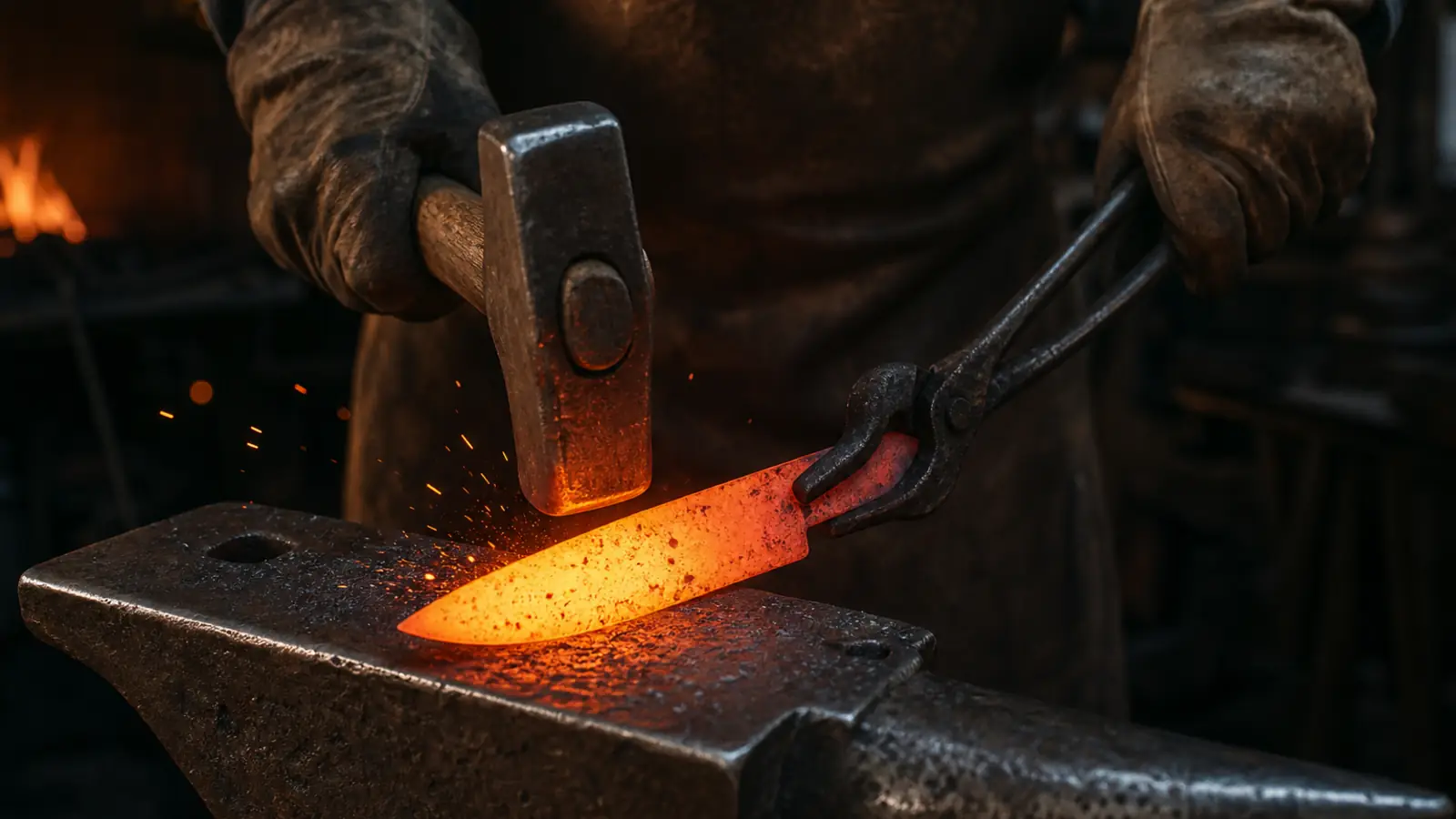
Straighten the spike first; most are slightly banana-shaped from service or the bin. Then draw the blade: work the pointed half of the shank over the far edge of the anvil or with the cross-peen, lengthening and flattening until you have roughly doubled it into a blade preform. Set the point, then forge the bevels, leaving the edge a thick 0.05 in or so.
The twist is the signature move. Reheat just the middle of the shank to an even bright orange - even heat makes an even twist - clamp the blade flat in a post vise, fit an adjustable wrench over the head, and pull one to two full revolutions. True everything straight on the anvil face with soft wooden-mallet or light hammer taps, and the forging is done.
What hardness to actually expect
Carbon sets a hard ceiling on quenched hardness. A fully hardened 0.30 percent carbon steel tops out around 47 HRC in theory, and shop reality on spike knives is roughly 40 to 45 HRC after an aggressive quench - about lawn-mower-blade or machete territory. For contrast, a properly quenched 1084 blade tests 64-65 HRC before tempering. Run any steel through the heat treat and quench calculator and the gap is obvious.
There is a second problem: spikes are low carbon and low alloy, which means shallow hardenability. Oil is simply too slow for them - quench a spike knife in oil and a file will laugh at your heat treat. Getting anything measurable requires water, brine, or the super quench below, from a shade past nonmagnetic, around 1550F. The good news is that 0.3 percent carbon rarely cracks even in a violent quench.
In use, that hardness means the edge takes quickly and dulls quickly. It will open boxes, whittle kindling, and dress a campsite fine - it will not hold shaving-sharp through a weekend the way a 60 HRC blade does.
Super quench: squeezing the most from marginal steel
Super quench is a brine recipe developed by Robb Gunter and the metallurgy lab at Sandia National Laboratories after their old sodium hydroxide quench was banned. The salt raises cooling speed past plain water, and the detergents strip the insulating steam jacket off the steel, so shallow-hardening alloys transform before they miss the window. Documented results run about 42 to 45 HRC on plain mild steel, and an HC spike responds at the top of that range.
The standard mix: 5 gallons of water, 5 lb of plain salt, 32 oz of blue Dawn dish soap (28 oz if concentrated), and 8 oz of Shaklee Basic I or 7 oz of unscented Jet-Dry as a wetting agent. Stir it up before every quench, plunge from about 1550F with a slight swirl, and rinse the blade in clean water immediately afterward - the salt flash-rusts steel within minutes. When the blue mix turns green, it is spent; make a fresh batch.
Two cautions. Never use super quench on anything over about 0.5 percent carbon - real knife steel cracks in it. And treat the claims realistically: it is the most the steel has to give, not a loophole around chemistry.
Finishing the spike knife: lean into the look
A spike knife earns its keep on presentation, so finish it like the rustic piece it is. Wire-brush the twist and head while the steel still holds a little warmth and the gray mill scale burnishes to a soft sheen that people cannot stop handling. Grind and sand only the blade - a 120 to 220 grit satin is plenty - and leave the forged texture everywhere else.
For color, a mustard or vinegar patina darkens the blade and buys some rust resistance, and a light coat of paste wax over the whole knife, applied warm, seals the scale. Skip the polyurethane dip; it yellows and chips.
Sharpen with modest expectations: a slightly steeper edge, around 22 to 25 degrees per side, suits the soft steel and rolls less than a fine slicing bevel. Hand the knife over with honest advice - letter opener, camp beater, conversation piece - and a strop or fine stone touch-up will keep it useful for years.
When you want a real edge
A knife-sized bar of 1084 costs just a few dollars from any bladesmith supplier - see where to buy steel - and it hardens to roughly 20 points HRC more than the best spike ever will, in a simple oil quench with a kitchen-oven temper.
The smart play is both: forge spike knives to build hammer skills, practice twists, and stock the gift drawer, then follow the full how to forge a knife walkthrough on 1084 when you want a blade that earns a spot on your belt. Same forge, same hammer, same evening of work - one of them just starts with steel that can actually become a knife.
Check temps and quench for any steel
How to Forge a Railroad Spike Knife
- Straighten the spike Heat the shank to a bright orange (around 1800-2000F) and true it straight on the anvil face, rolling it as you tap. A straight start makes every later step easier.
- Draw out the blade Forge the pointed half of the shank over the far edge of the anvil or under the cross-peen, flattening and lengthening it to roughly double its length. Keep the spine line straight and reheat whenever the color dulls to red.
- Set the point and bevels Forge the tip to a point just above the centerline, then hammer in the bevels on both sides. Leave the edge a thick 0.05 in so it survives grinding and the quench.
- Twist the handle Take a slow, even bright-orange heat on the middle of the square shank only. Clamp the blade flat in a vise, fit a wrench over the head, and pull one to two full revolutions, then true the knife straight.
- Normalize Heat the blade section evenly to just past nonmagnetic and cool in still air. One or two cycles relieves forging stress and evens the grain before hardening.
- Rough grind Grind or file the bevels clean at 60-120 grit and dress the profile, keeping the edge about 0.03-0.05 in thick. Wire-brush the twist rather than grinding it - the scale texture is the look.
- Harden from about 1550F Heat the blade one shade past nonmagnetic and quench in warm water, brine, or super quench with a gentle swirl. Rinse immediately after any salt quench to stop flash rust.
- Temper lightly and finish Run one hour at 350F to knock the brittleness off the skin without giving up scarce hardness. Sand, sharpen with modest expectations, and seal the blade and twist with oil or paste wax.
Frequently asked questions
Are railroad spike knives good knives?
They are good projects and mediocre knives. Even HC spikes hold only about 0.30 to 0.34 percent carbon, so the blade tops out around 40-45 HRC with an aggressive quench - roughly machete hardness - while a basic 1084 blade runs near 60 HRC. A spike knife handles light camp chores and looks great doing it, but the edge needs frequent touch-ups and it should not be sold or treated as a hard-use blade.
What does HC stamped on a railroad spike mean?
Higher carbon - not high carbon. Under ASTM A65 and the AREMA track standards, HC marks a Grade 2 spike specified at about 0.30 percent carbon, versus roughly 0.12 to 0.20 percent for plain soft-steel spikes. By knife steel standards that is still low-to-medium carbon: 1084 carries almost three times as much. HC spikes are the best spikes for forging a blade, but they are not knife steel.
Is it illegal to take railroad spikes from the tracks?
Yes. The railroad right-of-way is private property, and the Federal Railroad Administration notes it is illegal to enter it anywhere other than a designated crossing - and spikes in the ballast still belong to the railroad, so removing them is theft under state law. Interfering with active track is treated far more seriously. Buy spikes from flea markets, scrap dealers, or new from a spike manufacturer for a dollar or two each.
How hard does a railroad spike knife get?
Plan on the low-to-mid 40s HRC at best. Carbon caps quenched hardness, and 0.30 percent carbon physically cannot reach the 58-61 HRC of a real knife. Getting even 40-45 HRC takes a fast quench - water, brine, or super quench from about 1550F - because spikes are shallow-hardening. A file will still bite slightly after the quench; that is the steel, not your technique.
Should you quench a railroad spike knife in oil or water?
Water or brine - oil is too slow for a low carbon, low alloy steel and leaves a spike knife essentially unhardened. Quench from a shade past nonmagnetic, about 1550F, into plain water, brine, or Robb Gunter's super quench for the best result. The usual cracking worry with water barely applies at 0.3 percent carbon. Rinse after any salt quench, and save the quench oil for real knife steel.
Where can you buy railroad spikes for forging?
Flea markets, antique malls, scrap dealers, and online marketplaces sell used spikes for roughly a dollar or two apiece, and railroad supply companies sell new HC spikes by the bucket at similar per-spike prices. Buying gives you a receipt and a clean conscience, and new HC spikes come with known chemistry. Look for the HC head stamp and pass on anything deeply pitted or bent.
Last verified 2026-07. Specs, sizes and market prices change - confirm details on the retailer page before buying.